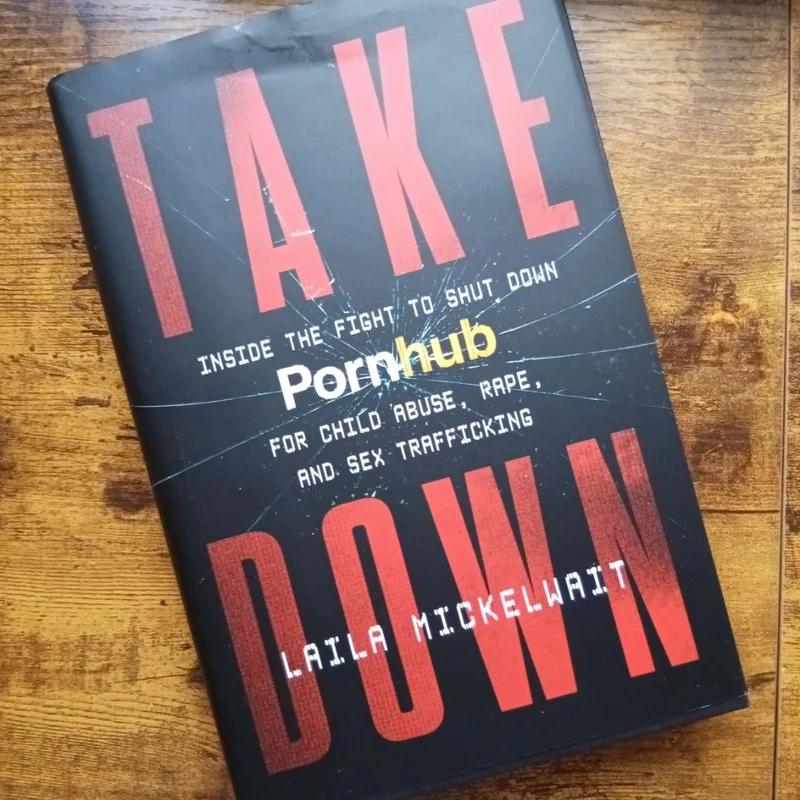
In Takedown, Laila Mickelwait recounts her campaign to hold Pornhub accountable for hosting evidence of child abuse and rape, and the extraordinary, messy reckoning that followed.
REVIEWED BY ADELEKE BABATUNDE
| TITLE | Takedown: Inside the Fight to Shut Down Pornhub for Child Abuse, Rape, and Sex Trafficking |
| AUTHOR | Laila Mickelwait |
| PUBLISHER | Worthy Books |
| PUBLISHED | July 2024 |
| PAGES | 336 pp. |
There is a particular kind of courage required to look directly at what most of us have decided, by unspoken agreement, not to see. Laila Mickelwait looked. In Takedown, her account of the campaign she launched against Pornhub and its parent company MindGeek, she describes discovering that one of the ten most-visited websites in the world, a platform generating hundreds of millions in annual revenue, was hosting, and in some cases actively monetizing, videos of child sexual abuse, rape, and sex trafficking. What she did next reshaped the internet.
The story Mickelwait tells is, on its face, almost unbelievable: a single activist, armed with a petition and a social media strategy, managing to move Visa, Mastercard, PayPal, and Discover to cut financial ties with the world’s largest pornography company. By the time her campaign reached its peak, Pornhub had deleted over 50 million videos, 91 percent of its entire archive, in what the Financial Timescalled, with some understatement, probably the biggest content takedown in internet history. The company’s chief executives resigned. Its secret majority shareholder was publicly named. Criminal charges followed. A federal judge stripped the platform of the Section 230 legal shield it had long relied on to avoid accountability for what its users uploaded.
“Mickelwait does something no amount of policy paper could: she makes the reader feel the stakes as a human emergency.”
Mickelwait is a gifted storyteller in the mold of the committed advocate, which is also to say that Takedown is not quite the book a seasoned journalist might have written about the same events. It is vivid, urgent, and occasionally breathless. It is also unambiguously partisan in the best sense: written by someone who was inside the fight, who wept with survivors, who fielded intimidation from MindGeek’s legal team, and who does not pretend to neutrality. She is the narrator and the hero of her own story, and readers should approach the book knowing that its emotional architecture is built around that fact.
This matters because the most powerful sections of the book are precisely those where her proximity to victims lends the narrative an unmediated human weight. Mickelwait spent years corresponding with women and men who had been recorded without consent, who had spent years begging the platform to remove footage of their assaults, only to be ignored or stonewalled while the videos accumulated views and generated advertising revenue. She does something no amount of policy paper could: she makes the reader feel the stakes as a human emergency rather than a regulatory abstraction.
* * *
To understand why Mickelwait’s fight was so difficult, one must first reckon with the sheer scale of the industry she was confronting. Pornography consumption has become nothing less than a silent pandemic, one that society struggles to name precisely because almost nobody confesses to it. Yet following the money tells the story with brutal clarity. The global online adult entertainment market was valued at $76 billion in 2024 and is projected to reach $118 billion by 2030. Pornhub alone receives over 100 million daily visits, and in a single month its traffic has been recorded as exceeding the combined audiences of Netflix, TikTok, Pinterest, and Instagram. Nearly 30 percent of all global internet traffic is estimated to be pornography-related. In the United States, 40 million people visit adult sites regularly, and approximately 11 percent of American adults consume such content daily. The average age of first exposure is now around eleven years old.
The platform economy has turbocharged this consumption in ways that would have been unimaginable a decade ago. OnlyFans, the subscription-based creator platform most associated with adult content, reported gross revenue of $7.22 billion in its 2024 fiscal year, a 9 percent increase over the prior year, with 377.5 million fan accounts and 4.6 million content creators on its books. Since its founding in 2019, fan spending on OnlyFans has grown by more than 2,500 percent. These are not the numbers of a fringe industry. They are the numbers of a mainstream one, operating largely without the public conversation its scale demands. The pandemic made it more so: when the world locked down, OnlyFans saw its gross revenue surge by 118 percent as millions turned to screens and, in many cases, to content creation as a livelihood. The industry did not merely survive the crisis. It fed on it.
“Nobody confesses to consuming pornography. But the money does not lie, and the money is staggering.”
The structural argument at the heart of Takedown is that Pornhub was not simply negligent. It was deliberately designed to evade accountability. Anonymous uploads were permitted for years not by oversight but by policy. At the time of the campaign’s peak, the company employed just 30 content moderators to review what was, by any measure, an incomprehensibly vast stream of daily uploads. Mickelwait traces how this was not the byproduct of a scrappy startup moving too fast but the calculated operating logic of a corporation that had decided the cost of moderation exceeded the cost of the harms enabled by its absence.
She also illuminates the financial ecosystem that made MindGeek’s impunity possible. For years, Visa and Mastercard processed payments on the platform without demanding any verification that the content was legal or consensual. When New York Times reporter Nicholas Kristof published a bombshell investigation in December 2020, an investigation Mickelwait had spent years helping to build, the credit card companies acted within days. The episode is a striking illustration of how quickly corporate behavior can change when reputational and financial incentives align. The tragedy, Mickelwait argues, is that they could have acted far sooner.
“Her critics raise questions worth sitting with, not because they exonerate MindGeek, but because they complicate the story’s tidy moral geometry.”
Yet the book also invites scrutiny that it does not always encourage its readers to apply. Mickelwait founded Traffickinghub while affiliated with Exodus Cry, an organization that describes pornography itself, not merely non-consensual content, as a public health crisis, and several of the campaign’s institutional allies had histories rooted in broader anti-pornography activism. Critics from the adult entertainment industry, including legal performers and producers, have argued that her campaign used evidence of genuine criminality as the opening wedge of a wider effort to regulate or eliminate consensual adult content entirely. Mickelwait is explicit that she draws a sharp distinction between consensual adult pornography and criminal material. But those who find that distinction less tidy than she does, or who worry about the downstream regulatory consequences of her campaign, raise questions worth sitting with, not because they exonerate MindGeek, but because they complicate the story’s moral geometry.
There are also, at times, gaps in the evidentiary framework that a more rigorous journalistic approach might have addressed. Pornhub’s representatives have noted that Mickelwait did not seek comment from the company before publication. Key claims about corporate intent, that executives knew rather than merely failed to prevent, are asserted with a certainty that the underlying documentation does not always fully support. These are not reasons to dismiss the book’s core revelations, which are extensively corroborated by other reporting and by legal proceedings. They are reasons to read it as what it is: a brilliant and important act of advocacy literature, not a dispassionate forensic account.
* * *
The real-life consequences Mickelwait catalyzed are, by now, a matter of public record that extends well beyond any single book. A federal class-action lawsuit has been certified in Alabama, allowing survivors to seek collective accountability. The U.S. Senate unanimously passed the TAKE IT DOWN Act, criminalizing non-consensual intimate image sharing and mandating its removal within 48 hours. Federal prosecutors in California filed criminal charges against MindGeek for allegedly profiting from the trafficking of more than 100 victims. And yet, as Mickelwait notes with evident frustration in her closing pages, Canada, where MindGeek was headquartered, has taken no equivalent action despite years of parliamentary investigation.
That frustration feels earned. Takedown is, at its core, a book about the distance between what powerful institutions know and what they choose to act upon, and about what happens when an ordinary person decides to close that distance by force of will. In a world where pornography has become one of the internet’s largest and least-scrutinized industries, that is not a small thing to say. Whether one shares Mickelwait’s every conviction or quarrels with her methods, there is no honest way to read this book without confronting the question of why it took so long for the rest of the world to catch up to what the survivors had been saying all along.
THE VERDICT
Takedown is a work of formidable moral urgency, an activist memoir that reads like a thriller and lands like an indictment. Its limitations are inseparable from its power: it is a book written from the inside, by someone who fought this battle at enormous personal cost, and it should be read as such. Approach it alongside the broader reporting it helped to spark, and it becomes essential. Approach it in isolation, and it is still impossible to put down.