
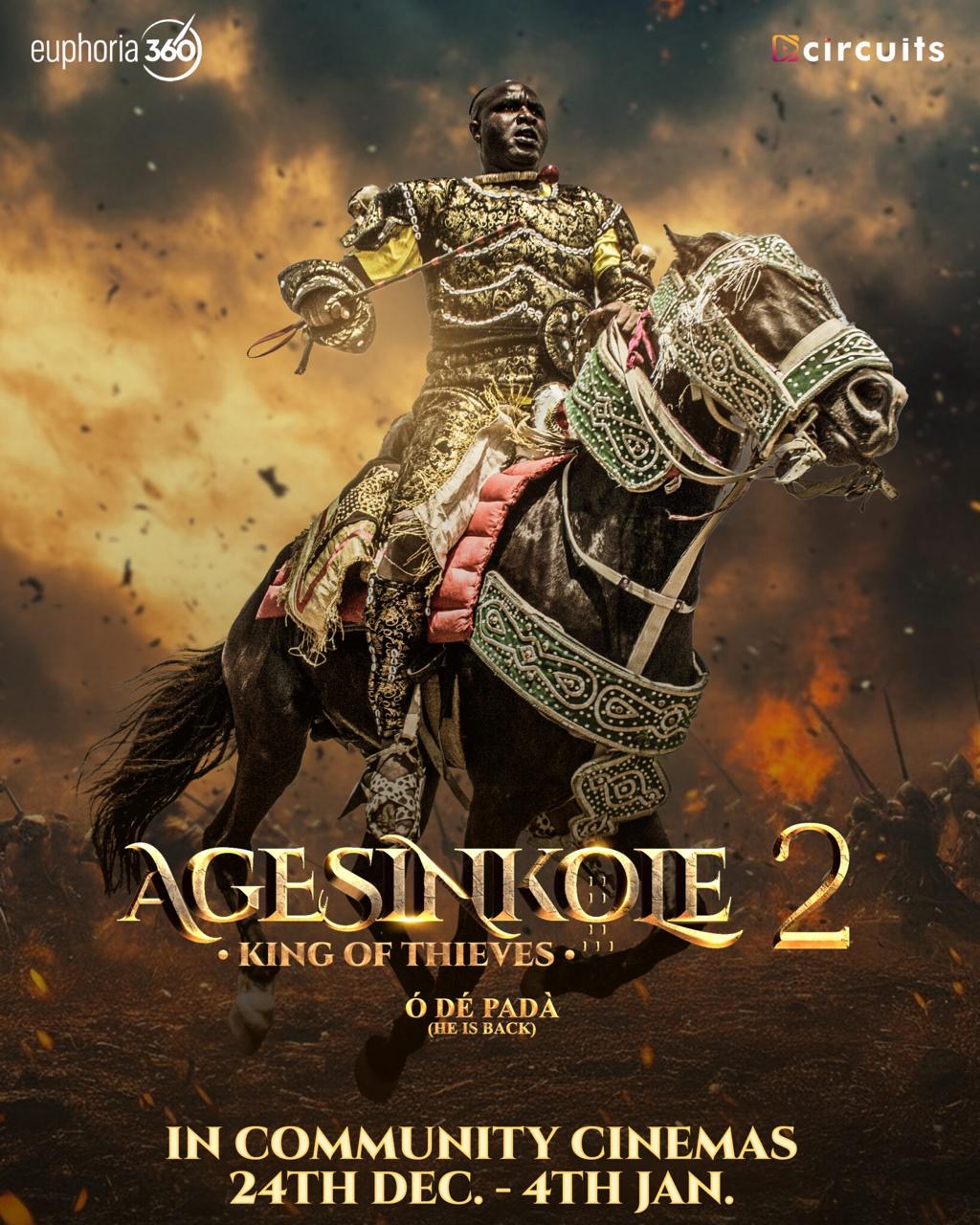
by Adeleke Babatunde
In December, I travelled to Abeokuta for Christmas, and one of the highlights was heading to the June 12 Cultural Centre in Kuto to catch a screening of Ageshinkole 2 (officially titled Ageshinkole 2: King of Thieves). The venue felt perfectly suited for the occasion: the open-air energy of the cultural centre, the crowd settling in with holiday buzz, and the anticipation of a Yoruba epic that had been talked about since the first film’s success in 2022. It turned out to be a nice watch overall, delivered by a solid troupe with strong production values and cultural authenticity that made the evening memorable.
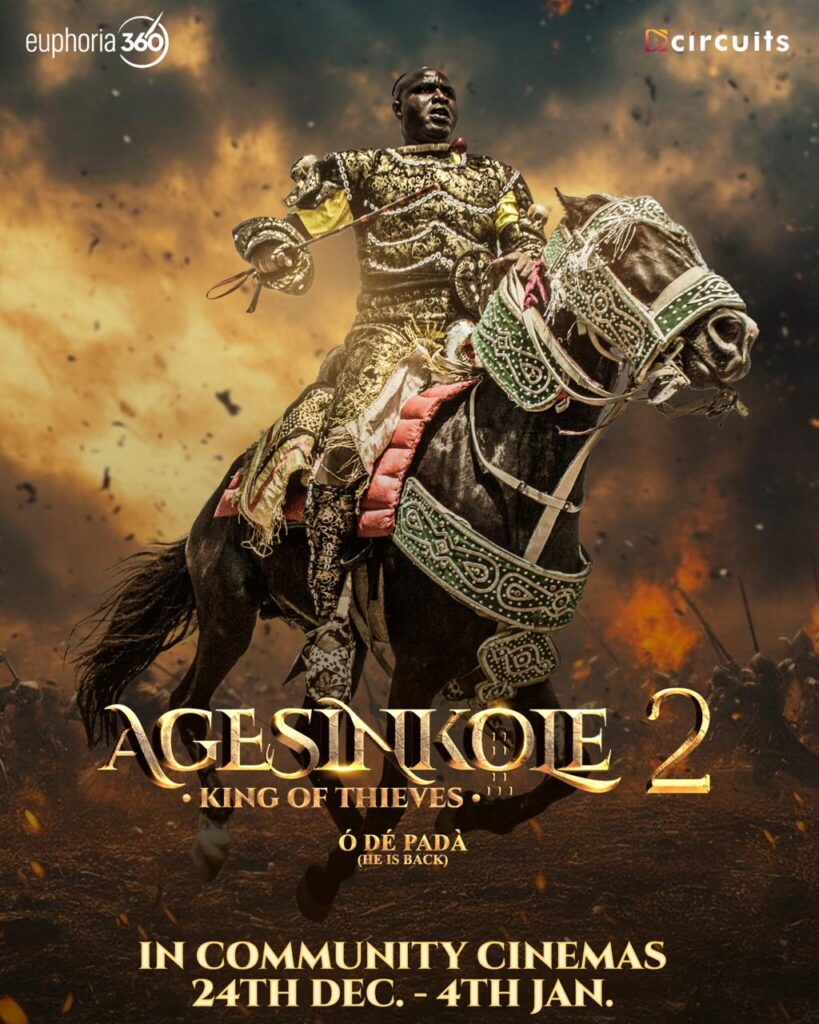
The storyline expands the legend of Agesinkole from the original film, where he emerged as a notorious yet justice-driven bandit who terrorised the kingdom of Ajeromi to punish corruption. In this sequel, the focus shifts to a new corrupt king whose abuses of power eventually summon divine retribution in the form of Agesinkole, portrayed as a near-mythical enforcer or deity-like figure embodying the wrath of the oppressed and the gods. The plot follows the king’s descent into tyranny: he exploits his subjects through heavy taxation, betrayal of traditional oaths, oppression of the palace court, and personal greed that disrupts communal harmony. As the kingdom suffers famine, unrest, and spiritual imbalance, Agesinkole re-emerges dramatically, striking terror into the wicked while offering hope to the weary. The narrative builds through court intrigues, betrayals among nobles, invocations of orishas, and escalating confrontations, culminating in a climactic showdown where Agesinkole delivers inevitable justice, restoring balance to Ajeromi. The film blends Yoruba mythology, epic action, suspense, moral commentary, and touches of drama and comedy, reinforcing that legends do not die but wait for the right moment to return.
A key subplot that adds layers to the king’s corruption involves the disappearance of the princess, a young royal figure whose sudden vanishing serves as a catalyst for escalating chaos in the kingdom. The princess, portrayed as an innocent symbol of the kingdom’s future and purity, goes missing amid whispers of foul play linked to her lover’s family. His parents were eventually harshly executed in a heavy-handed ruling by the king.

The princess eventually returns of her own volition. But wiithout deeper dialogue or flashbacks to build sympathy or complexity. We are left with more questions than answers, what could have been a deep moment only serves as a mere plot device to propel Agesinkole’s intervention. This lack of framing leaves the audience with unresolved questions: Who was guilty? Did the princess’s disappearance tie directly to kingdom issue?
What stood out positively was the troupe’s performance and the production quality. Femi Adebayo and the ensemble delivered commanding presence, with costumes capturing pre-colonial Yoruba royalty and warrior aesthetics: rich aso-oke fabrics, intricate beadwork, coral crowns, and battle-ready attire that felt authentic. Props and set design leaned into the period—palace thrones carved with traditional motifs, village scenes with thatched roofs and communal spaces, ritual objects like staffs and calabashes used in invocations. The cinematography made good use of natural lighting and dramatic angles, especially in night sequences with firelight and shadows that heightened the supernatural tension. Sound design incorporated traditional Yoruba instruments (talking drums, flutes, and chants) effectively, building suspense during confrontations and providing emotional depth in quieter moments.
The lessons were well picked and delivered without feeling forced. The film espousedcore Yoruba moral principles: unchecked power corrupts absolutely, justice (even if delayed) comes from higher forces, and the community suffers when leaders prioritise self-interest over collective welfare. Agesinkole functions as a symbolic deity of retribution, echoing Yoruba concepts of balance (ìwọ̀ntúnwọ̀nsì) and the idea that the gods intervene when human systems fail. These themes resonated strongly in the festive context; watching during Christmas added an interesting layer, as the story’s emphasis on justice and accountability mirrored broader reflections on leadership and equity that many Nigerians carry into the new year.
That said, the storyline could have been better framed for greater impact. While the moral arc is clear, the pacing occasionally drags in the middle sections, with some subplots (court intrigues, secondary betrayals) feeling repetitive or underdeveloped. A tighter script could have sharpened the buildup to the climactic justice scene, making the payoff feel even more earned and cathartic. A few anachronistic props or minor inconsistencies in set dressing (modern-looking elements in a supposedly ancient setting) stood out, though they were minor compared to the overall effort.
Despite using the community cinema style, exclusive rollout in Southwest venues like viewing centres, halls, and local cinemas rather than nationwide traditional chains, Ageshinkole 2 achieved remarkable commercial success. According to figures announced by Femi Adebayo and reported across Nigerian media (including Nairametrics, and BusinessDay), the film grossed ₦417 million in just 12 days. This performance makes it the most successful recorded Nollywood title distributed through community cinemas, with more than ₦5.8 million coming from traditional box office and the majority from these grassroots venues. Ticket prices were kept affordable (₦4,000 in Lagos, ₦3,000 elsewhere), allowing direct access for audiences in familiar local spots without heavy marketing or national push. This unconventional strategy not only shattered expectations but highlighted the power of community-driven distribution in Nollywood, proving that targeted, culturally resonant storytelling can thrive outside mainstream cinema circuits.