by Adeleke Babatunde
When a government agency voluntarily publishes unflinching monthly pollution data without scandal and without being dragged, something profound is shifting in how Africa’s largest city is governed.
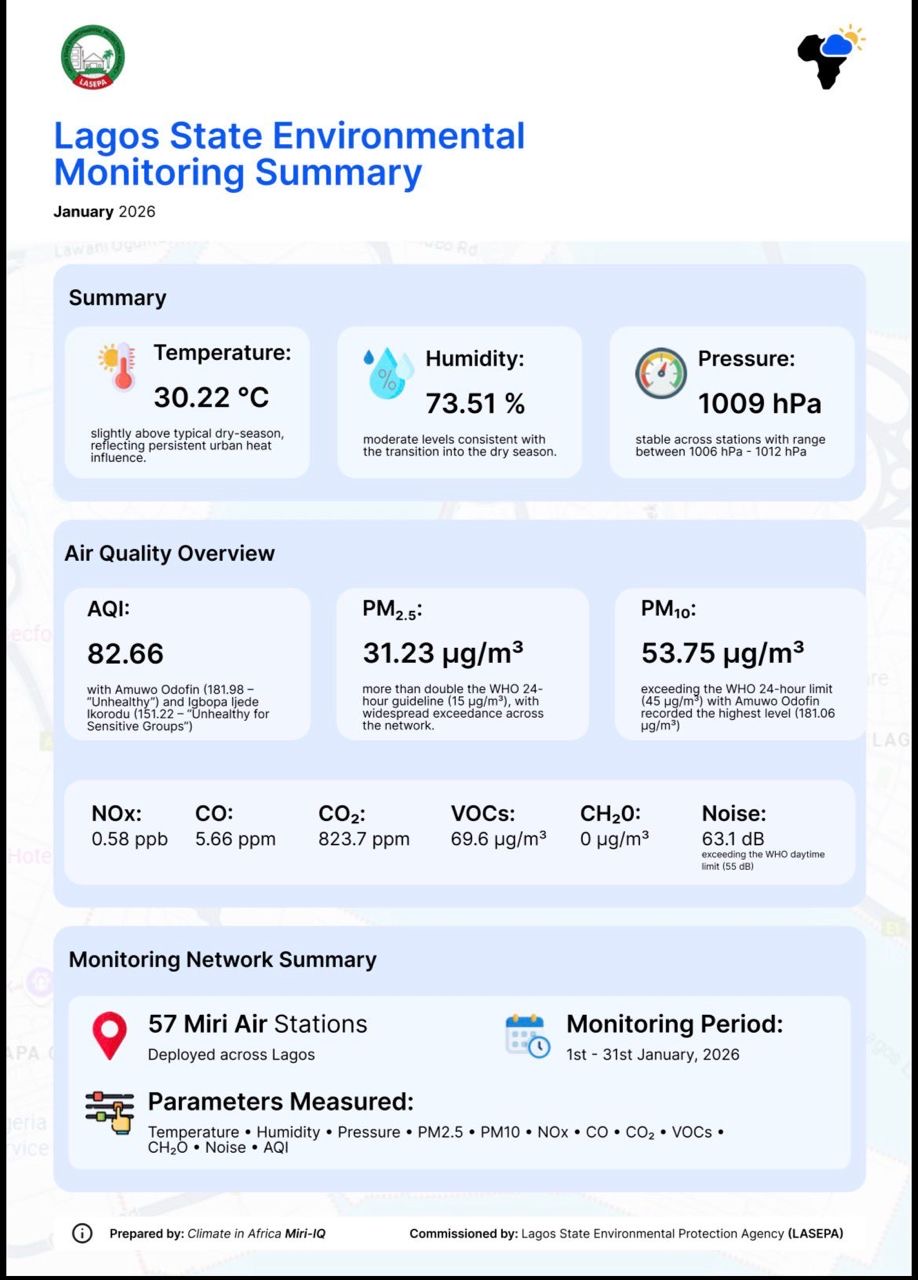
LASEPA’s January 2026 Environmental Monitoring Summary landed quietly but landed hard. The numbers demand attention, not admiration.
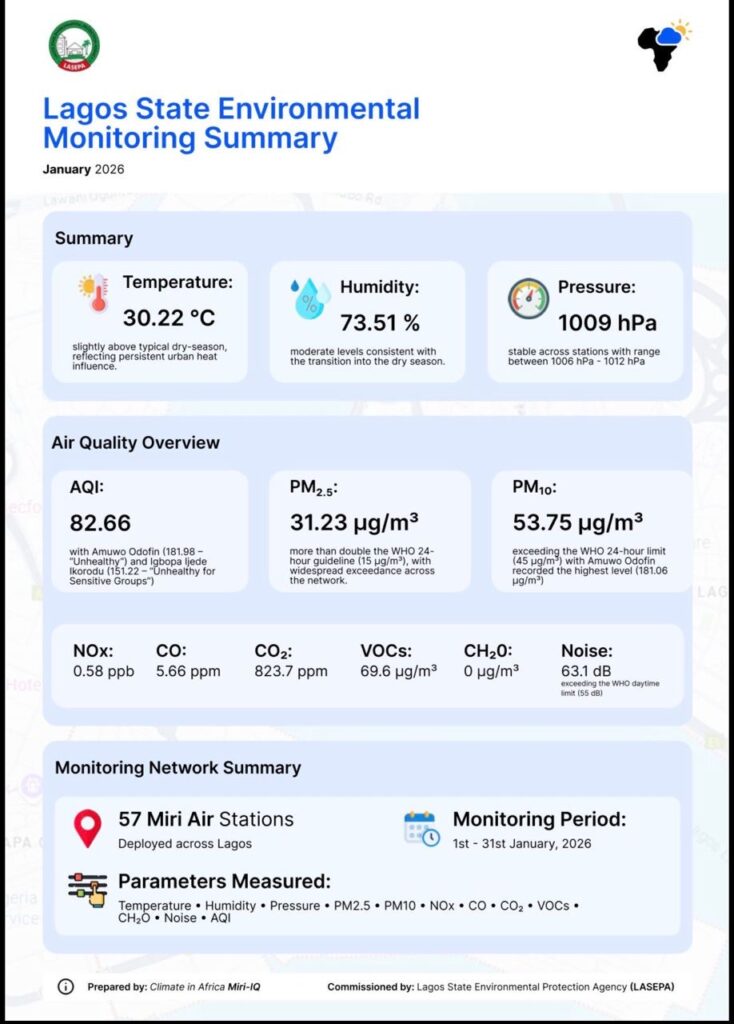
Amuwo Odofin recorded an Air Quality Index of 181.98, firmly in the “Unhealthy” category. Every breath in that zone carries a measurable risk of inflammation, asthma attacks, hospital visits, lost school days, and shortened lives. Igbopa Ijede in Ikorodu followed at 151.22, classified as “Unhealthy for Sensitive Groups.” That polite bureaucratic phrase means children, the elderly, and anyone with lungs already scarred by years of exposure should limit time outdoors. Across the state, PM2.5 concentrations averaged more than double the World Health Organization’s strict 24-hour guideline. Noise pollution, that insidious sleep-stealing and stress-inducing constant, averaged 63.1 decibels, well above daytime safety thresholds recommended by international health bodies.
These are not distant statistics. They explain why a mother in Amuwo Odofin keeps her asthmatic child indoors during rush hour. They explain why an elderly resident in Ikorodu struggles to sleep through the night. They represent the hidden health tax thousands of Lagosians pay every day for living in a megacity still powered largely by diesel generators, choked traffic, and unchecked industrial emissions.
What sets this moment apart is not the pollution itself. Cities of 20 million people rarely eradicate it overnight. What stands out is the institutional courage to measure it rigorously, publish it promptly, and act on it transparently.
Under General Manager Dr. Babatunde Ajayi, LASEPA has moved from complaint-triggered episodic enforcement to a system built on continuous science-driven intelligence. The agency now operates over 100 air quality monitoring stations with ambitions to reach 200 by year’s end. These feed a public dashboard at air.lasepa.gov.ng that anyone can access in real time. Weekly updates, monthly summaries, hotspot identification, and targeted deployments of enforcement teams are now standard operating procedure.
This shift required political will from the Ministry of the Environment and Water Resources, led by Honourable Commissioner Tokunbo Wahab. His insistence on accountability, innovation, and cross-agency collaboration created fertile ground for reform. The partnership between a commissioner who demands measurable outcomes and a general manager who delivers them through data and discipline is proving transformative.
Transparency here is not performative. LASEPA could have waited for cleaner months to showcase progress. Instead it released January’s sobering reality unvarnished, then followed with clear statements: enforcement teams are active, inspections are intensified, hotspots are prioritized. This is governance as a discipline: quiet, consistent, and accountable to evidence rather than optics.
The challenges remain structural and daunting: generator dependency amid unreliable grid power, congested roads burning dirty fuel, industrial clusters without adequate controls, dense urban living that amplifies every emission. No single monthly report pretends otherwise. What it offers is a baseline, a mirror, and a promise of response.
The real audience for this data is not foreign donors or headline writers. It is the residents of Amuwo Odofin, Igbopa Ijede, Agege, Mushin, and every neighborhood where the air feels heavy and the nights are loud. They now have access to the same facts their government holds. They can track trends month by month. They can demand that promised interventions deliver results. They can become co-owners of the solution.
This is how public trust is rebuilt: not through grand pronouncements, but through the patient unglamorous habit of showing up with honest numbers, explaining them plainly, and following through with action.
A technical report dense with figures and regulatory prose has become something rarer: proof that a public institution can treat citizens as capable partners rather than passive recipients. If this practice endures under Dr. Ajayi and Commissioner Wahab, it may prove more consequential for Lagos’s future than any single regulation or fine.
The January data tells us exactly where we stand. The leadership now in place tells us we no longer have to stand still.
Lagosians: visit air.lasepa.gov.ng . Read the numbers. Share them. Hold the system to its own standard. Clean air is not a luxury. It is a right. And for the first time in a long while, the machinery of government is acting like it believes that too.
Babatunde Adeleke writes from Egbeda, Lagos