
… Tokunbo Wahab: Collaboration driving preventive public health response
Babajide Fadoju
The Lagos State Environmental Protection Agency (LASEPA), in partnership with the United Nations Industrial Development Organization (UNIDO) and the Government of Japan, has concluded a one-year capacity-building programme designed to prevent cholera outbreaks in flood-prone communities across Lagos State.

The initiative was implemented under UNIDO Project 240237 titled “Emergency Capacity Building of Informal Food and Water Vendors and Waste Workers in Flood-Affected Lagos to Combat Cholera Outbreaks.” The project focused on strengthening hygiene practices, waste management systems and community awareness to reduce disease transmission risks.
The closing ceremony took place in Lagos, marking the end of a 12-month intervention introduced following the cholera outbreak recorded in June 2024, when 579 suspected cases and 29 deaths were reported in the state. The outbreak exposed sanitation gaps and unsafe waste disposal practices within vulnerable communities.

The programme targeted informal food and water vendors as well as waste workers who operate within flood-affected areas considered highly susceptible to waterborne diseases.
Tokunbo Wahab: Collaboration driving preventive public health response
Speaking at the event, Lagos State Commissioner for the Environment and Water Resources, Tokunbo Wahab, described the initiative as a proactive collaboration aimed at breaking the chain of cholera transmission through grassroots engagement.
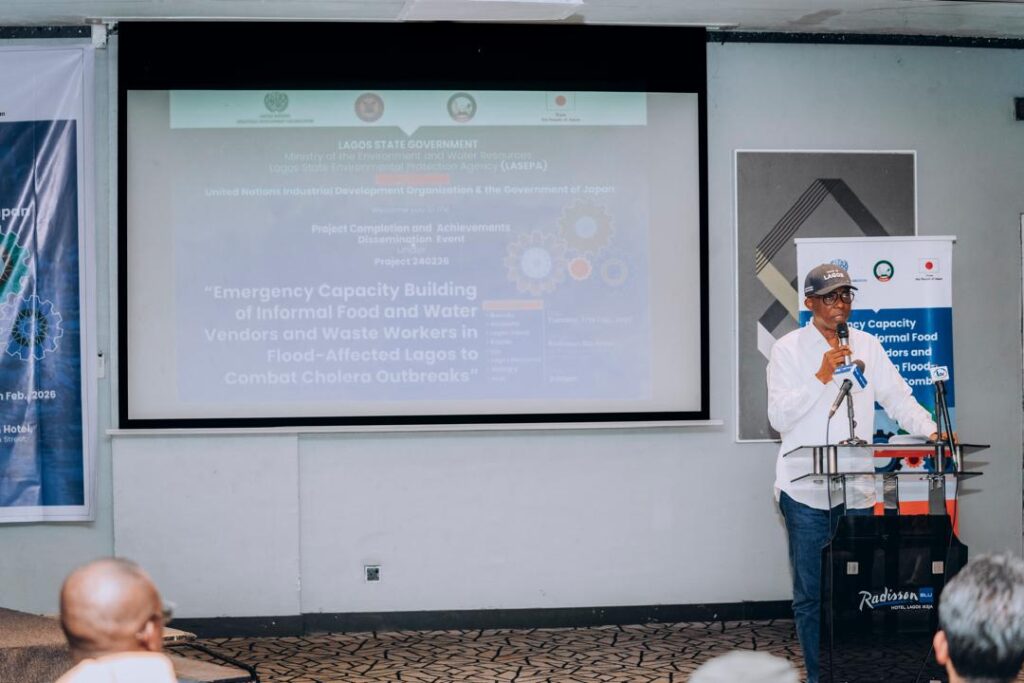
He disclosed that the Government of Japan, through UNIDO, provided a $225,000 grant supporting interventions across eight flood-prone local government areas: Ikorodu, Alimosho, Lagos Island, Ojo, Kosofe, Lagos Mainland, Badagry and Ikeja.
According to the commissioner, 1,054 residents were sensitised during the first phase of the project, including 623 women and 431 men. The second phase provided hands-on training for 452 informal food and water vendors and waste workers on hygiene standards, safe handling of food and water, and improved waste disposal practices.
Wahab noted that since the commencement of the programme in April 2025, Lagos State has not recorded any new cholera outbreak, describing the outcome as evidence that preventive measures and community ownership are producing positive results.

He also highlighted complementary environmental interventions undertaken by the state government, including statewide drainage maintenance and desilting operations, the award of 210 drainage infrastructure projects, and de-flooding works carried out in 18 public schools.
The commissioner further referenced a memorandum of understanding signed with Zoomlion Ghana Limited for the establishment of material recovery facilities in Epe and Badagry to strengthen sustainable solid and liquid waste management.
LASEPA General Manager, Babatunde Ajayi, in his welcome address, said the agency engaged directly with informal food vendors and waste workers during field operations. He explained that assessments conducted in rural, riverine and flood-prone communities revealed persistent sanitation challenges that required targeted intervention.
Ajayi added that the frameworks and lessons developed under the project would be integrated into LASEPA’s enforcement and advocacy programmes to sustain public health protection across the state.
The Director and UNIDO Representative to Nigeria and ECOWAS, Philbert Johnson, described the initiative as a strong example of the connection between public health protection and sustainable development. He noted that the programme delivered training-of-trainers sessions, community outreach activities and essential response tools such as rapid diagnostic kits and water purification materials.
Also speaking, Japan’s Ambassador to Nigeria, Hideo Suzuki, reaffirmed Japan’s commitment to supporting Nigeria’s efforts to combat cholera and other infectious diseases.
He disclosed that Japan is funding two additional cholera-related interventions through the World Health Organization and United Nations Office for Project Services (UNOPS), bringing its total contribution to about $1.725 million.
Suzuki stressed that cholera remains preventable and emphasised the importance of sustained investment in hygiene awareness, sanitation infrastructure and community engagement to achieve zero mortality.