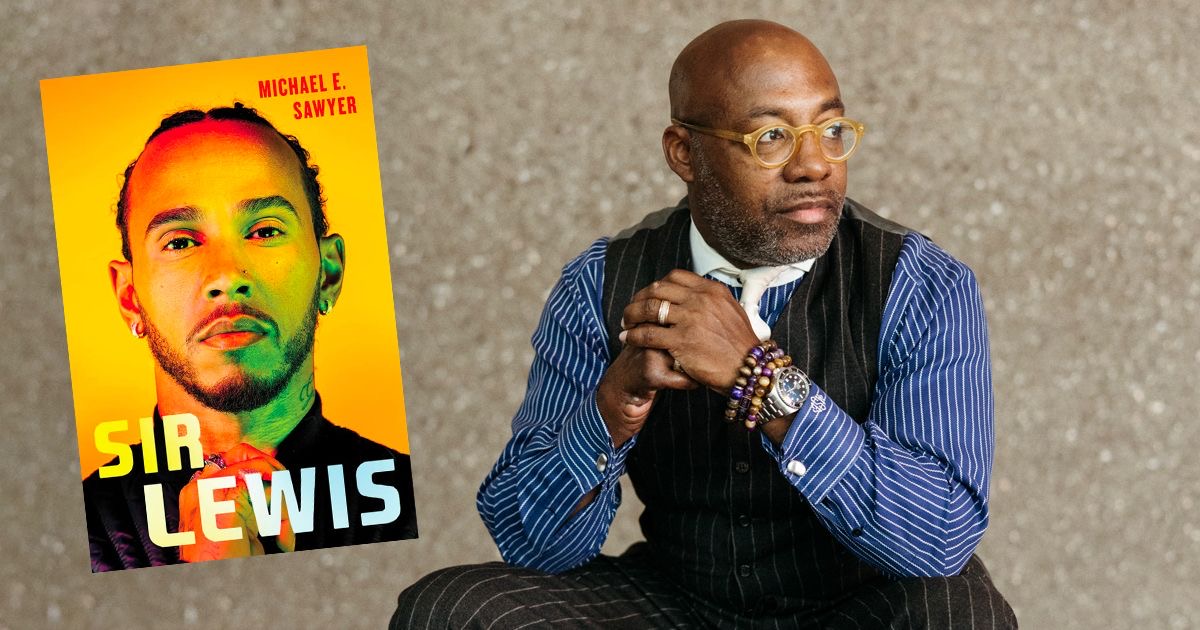
by Michael E. Sawyer
Grand Central Publishing / LegacyLit, 2025
Review by Adeleke Babatunde
There is a question buried at the heart of Michael E. Sawyer’s Sir Lewis that never quite resolves itself, and it is the most interesting question the book raises: can a text be simultaneously a cultural argument and a biography, serving both masters with equal rigor? The tension between those two modes of writing is what drives this book forward, and also what occasionally trips it. But understanding that tension and why it exists tells you almost everything about Lewis Hamilton himself, about the sport he transformed, and about what we ask of Black athletes who dare to be extraordinary.
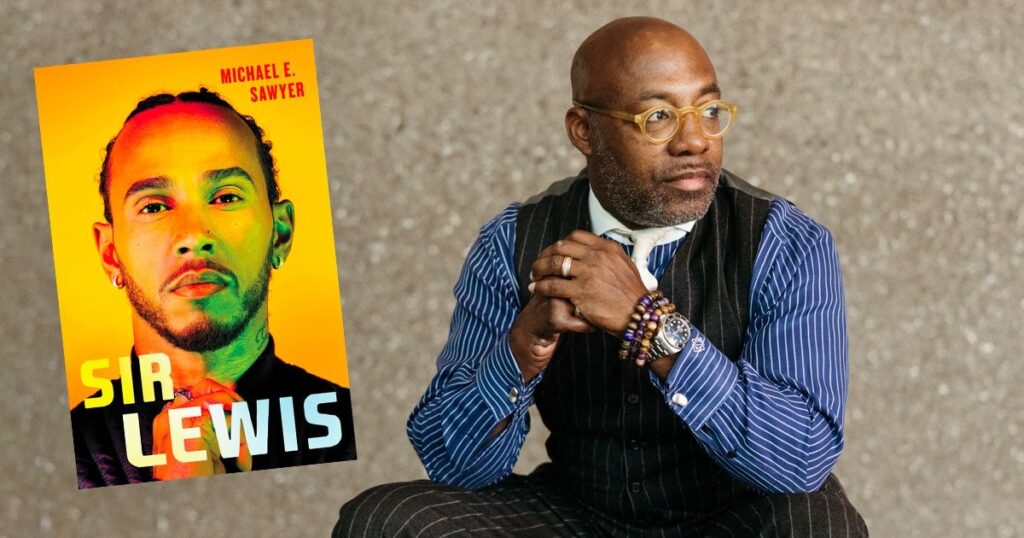
Sawyer is a professor of African American Literature and Culture at the University of Pittsburgh, a former U.S. Naval officer, and a lifelong Formula One fan since his posting in Italy in 1991. Those three identities fuse in Sir Lewis in ways that are sometimes seamless and at other times awkward. The book is, at its core, a cultural biography, a term Sawyer himself appears to prefer rather than a conventional sports narrative. He is not trying to write the definitive lap-by-lap account of Hamilton’s career. He is trying to place Hamilton inside a tradition of Black excellence, resistance, and singular achievement that stretches from Muhammad Ali to Serena Williams to Colin Kaepernick, and to ask what it costs a man to be the first of his kind at the very top of the most exclusive sport on the planet.
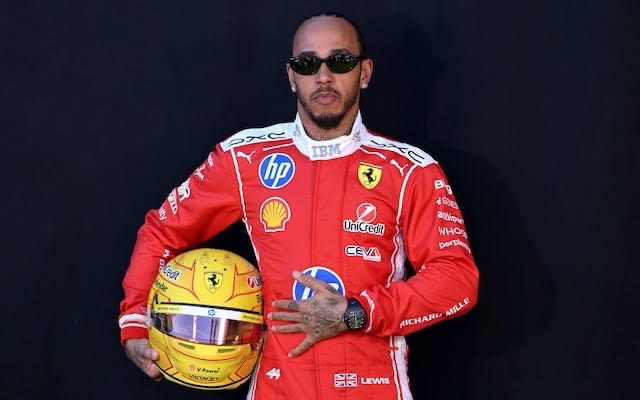
As a F1 fan myself, a black man, I found that Professor Sawyer was more tilted towards the black man than the athlete. Nevertheless, this is a worthy and necessary project. Whether Sir Lewis fully stays the course is a more complicated question.
Sawyer describes his project as an attempt to examine and critique every institution Hamilton is involved with through a lens of race, ethnicity, religion, gender, sexuality, and class. That is an extraordinarily ambitious mandate for 248 pages covering a man who has been a public figure since he was 13 years old, who has won 103 Grands Prix, and who has sat at the top of fashion, advocacy, and motorsport simultaneously. What Sawyer is really asking, and this matters, is not just how Lewis Hamilton won seven world championships. He is asking how Lewis Hamilton managed to survive long enough to do it.
In 2007, Formula One was not ready for Lewis Hamilton. That is not a provocative statement; it is the plain, documented truth. When Hamilton arrived at McLaren as a 22-year-old, he was not merely an outsider in the sense of being unproven. He was an outsider in the most fundamental demographic sense, the only Black driver in a sport dominated by wealthy Europeans and Latin Americans, owned and managed almost exclusively by white men, watched by a largely white fanbase, and largely absent from communities of colour in every country where it raced. The sport had no existing framework for him. It still, in many ways, does not.
Sawyer’s most penetrating contribution is how he illustrates the psychological and sociological machinery that kicks in when a Black person achieves dominance in a white-majority space. When Hamilton won his first championship, the instinct in parts of the media and the paddock was not to celebrate but to explain the win away. He had the best car. He was lucky. His team helped him too much. Sawyer draws this out carefully, noting the parallel experience of Tiger Woods, who endured the same explanatory reflex in golf: the suspicion that dominant Black excellence must have a structural cause rather than a personal one. It is a specific kind of racism, less crude than a slur, more insidious because it sounds almost reasonable.
This is where the book is at its sharpest. Sawyer brings genuine academic depth to these passages. His reading of the 2007 McLaren-Alonso dynamic, in which Fernando Alonso, Hamilton’s teammate and at that point the reigning two-time world champion, reportedly went to team management to complain about receiving equal treatment to a rookie, is particularly clear-eyed. Alonso’s reaction was not simply about competitiveness. It was about status. Hamilton was not supposed to be his equal. The machinery of the sport, from the team hierarchy to the press coverage, had been built on an assumption that drivers like Hamilton did not exist.
The Stevenage Origin and the Weight of Anthony Hamilton
The book’s sections on Hamilton’s childhood are among its most effective, and the figure at their centre is not Lewis but his father, Anthony Hamilton. Anthony’s story is the foundation of everything. A Grenadian immigrant who worked multiple jobs simultaneously to fund his son’s karting career, who managed Lewis’s early racing years with a shrewdness and commitment that most professional managers would struggle to match, Anthony Hamilton is one of the most important figures in British sporting history, and almost nobody outside of F1 circles knows who he is.
Sawyer understands that Anthony’s sacrifices were not simply parental devotion. They were an act of deliberate counter-narrative. To put a Black British child into kart racing in the 1990s, to fund it with your own labour, to navigate the political machinery of racing governance on behalf of a child who was already being watched differently, that required a particular kind of resolve. It required the understanding that the system would not make accommodations, and that the only option was to be so undeniably excellent that the system had no grounds to exclude you.
This is the framework that Hamilton has carried into his entire career. The logic of being so good that exclusion becomes untenable is a logic deeply familiar to Black professionals in white-majority industries, and Sawyer traces it with care. But he also, importantly, notes its cost. Being the standard-bearer of an entire community’s aspirations while competing at the highest levels of any sport is an extraordinary psychological burden. Hamilton has spoken about this burden himself, about the loneliness of being singular, about the pressure not merely to win but to represent.
Abu Dhabi 2021: The Wound That Won’t Close
The 2021 season finale at Abu Dhabi is the defining event of Hamilton’s late career, and Sawyer gives it substantial attention. The facts are well-documented. Max Verstappen went into the final race of the season level on points with Hamilton. In the closing laps, Hamilton led comfortably and appeared to be heading for an eighth world championship. A late safety car deployment, and the subsequent decision by race director Michael Masi to apply the restart rules in a manner with no clear precedent, left Verstappen on fresher tyres directly behind Hamilton for one final lap. Verstappen passed him. Hamilton had the championship taken from him.
What Sawyer does well here is excavate the responses to Abu Dhabi not just within the paddock, but across social media, among fans, and in the press. He documents how quickly the narrative fractured along pre-existing lines. Those who had always found Hamilton difficult to celebrate, who had always been slightly discomfited by his outspokenness on race and justice, found ways to rationalise the decision, to diminish his grievance, to suggest he was being ungracious in defeat. Those who had followed Hamilton’s career with the additional weight of knowing what he represented found in Abu Dhabi a confirmation of something they had long suspected: that the rules, when applied loosely, would be applied loosely against him.
Whether or not Masi’s decision was racially motivated is unknowable, and Sawyer is careful not to assert that it was. What he does argue and the argument is sound is that the response to Hamilton’s anger about the decision was shaped by racial assumptions. A white driver who had been denied an eighth championship under those circumstances would likely have been treated as tragic, heroic even. Hamilton was treated, in parts of the press and among segments of fandom, as difficult, as a sore loser, as someone who should simply move on. The title of the book comes from George Lucas’s response to the Abu Dhabi debacle, a simple, dignified acknowledgment of who Hamilton is and what was done.
The Athlete-Activist: What Hamilton Chose to Risk
The sections of Sir Lewis dealing with Hamilton’s social activism are among the most culturally significant parts of the book, and they connect directly to the political moment in which it was written and published. Sawyer charts how Hamilton evolved from a driver who was relatively guarded on political topics in his early career into someone who, in 2020, took a knee on the grid before Grands Prix, wore a Black Lives Matter helmet, called out specific incidents of police brutality by name, and founded the Hamilton Commission to investigate systemic exclusion of Black people and other minorities from motorsport.
Sawyer draws the comparison to American athlete-activists explicitly and with genuine intellectual force. The tradition he is placing Hamilton within, Ali refusing the draft, Kaepernick kneeling, Tommie Smith and John Carlos on the podium in Mexico City 1968, is a tradition defined by the choice to use athletic visibility for a moral purpose at high personal and professional cost. Hamilton’s position was, if anything, more politically complex than any of these predecessors. He was operating in a British and European context, where the discourse around race operates very differently from the American context with which most of his audience was most familiar. He was speaking to a fandom that was still largely resistant to the idea that F1 had a race problem at all.
The book is acute on one specific dynamic: the way Hamilton’s activism was framed as a distraction from his racing by precisely the commentators who would never have characterised a white driver’s political opinions as a distraction. When Sebastian Vettel began wearing T-shirts in support of LGBTQ+ rights and environmental causes, the reception was broadly warm. When Hamilton wore a BLM helmet, sections of the sport treated it as a controversy. Sawyer does not overstate this observation, but it lands.
Sawyer also notes the particular difficulty faced by Black athletes who speak publicly about race in European contexts, where the instinct is to claim that race is an American problem, that European societies have moved beyond this, and that bringing up race is itself the divisive act. Hamilton has never accepted this framing. His willingness to name what he saw, in a context where naming it made him the problem rather than the thing he was naming, is one of the genuine acts of courage in his public life.
It would be dishonest to review Sir Lewis without engaging with its structural weaknesses, because they are significant and they matter to the project Sawyer is attempting.
The most frequently cited problem, and it is a legitimate one, is the source selection. Sawyer relies heavily on journalism, both recent and archival, and too little discernment has been applied in choosing which journalism. Credible national publications appear alongside material from content farms and aggregator sites of negligible editorial value. More problematically, the book contains no original interviews. For a biography published in 2025 of a man who was, at the time of writing, still actively racing, this is a genuine gap. It means the book’s understanding of Hamilton’s interiority is necessarily second-hand, filtered through press conferences, previously published interviews, and Sawyer’s own interpretive framework.
There are factual errors regarding other teams and drivers that will frustrate readers who know the sport well. Fernando Alonso did not win his championships at Williams. Ross Brawn was not at Honda for Schumacher’s titles. These may seem like minor details, but in a book staking a claim to definitiveness in one of the most detail-obsessed sports on earth, they corrode credibility in ways that matter.
The characterisation of rival drivers is occasionally too schematic. Verstappen and Alonso are drawn as antagonists, which fits the narrative Sawyer is building, but flattens what are actually quite complex relationships. Alonso, in particular, is a more interesting figure than this book allows a driver whose own experiences of team politics and institutional resistance at McLaren were, in some ways, not entirely unlike Hamilton’s, even if the racial dimension was absent.
The pacing is uneven. Hamilton’s debut season in 2007 receives a disproportionate share of the book’s attention, nearly a quarter of the chapters. This makes sense thematically; 2007 is where everything that Sawyer wants to argue about Hamilton was established in its clearest form. But it means the later career, including the extraordinary 2019-2020 period when Hamilton reached the peak of his technical and activist powers simultaneously, is compressed and rushed. The book begins to feel like it is summarising rather than interrogating by its final third.
A sharper edit, fewer block quotations from press conferences, and a more rigorous source standard would have made this a significantly stronger book. What Sawyer has to say is often genuinely worth saying. The delivery sometimes obscures it.
Hamilton at Ferrari, and Why the Timing of This Book Matters
Sir Lewis was published in March 2025, as Hamilton’s first season at Ferrari was just beginning. The book ends with what it frames as a potential final act of Hamilton at the wheel of the sport’s most iconic team, chasing a record-breaking eighth championship. What Sawyer could not know when he finished writing was how the first year in red would unfold.
It was the worst season of Hamilton’s career. He finished 2025 without a single podium, the first season he had failed to reach the top three in his entire time in Formula One, and the first time a Ferrari driver had gone a full year without a podium in 44 years. He struggled with the SF-25’s characteristics, found himself regularly outpaced by teammate Charles Leclerc, and described the year himself as the hardest of his career. The gap between the promise of the Ferrari move and the reality of it was painful to watch.
And yet this is also, perversely, where the book’s central argument becomes more rather than less relevant. Because what happened in 2025 was not a simple story of decline. It was a story about a 40-year-old man who had spent 12 years developing a near-telepathic relationship with one manufacturer’s cars, who moved to a completely different technical philosophy and culture, and who struggled publicly and visibly while refusing to quit. The Hamilton of 2025 was doing something the comfortable narrative of decline and graceful exit would not accommodate: he was fighting.
Heading into 2026, the framing has shifted. The new technical regulations represent a comprehensive reset of the sport. Ferrari, by all pre-season accounts, appears to have built a competitive car. Hamilton himself, speaking from Bahrain testing in early 2026, described feeling more connected to the new SF-26 than to any car since the regulation change of 2022. There is a bounce in his step that was notably absent through much of 2025. He has spoken of feeling in the best place he has been for a long time. These are not the words of a man who is winding down gracefully. They are the words of a man who has been waiting.
Sawyer wrote about Hamilton’s Ferrari chapter as a potential final act. It is beginning to look more like a second chapter. Whether that second chapter delivers an eighth championship will determine how the book’s ending reads retroactively and whether the project Sawyer frames, of Hamilton validating his greatness at the wheel of the Prancing Horse, becomes complete.
The Question of the Definitive Biography
The book’s subtitle calls itself the definitive biography. This is marketing language, but it is also a claim worth taking seriously. Is Sir Lewis definitive?
It is definitive in the sense that it is the first book to place Hamilton’s story explicitly and rigorously within a framework of Black cultural history and race theory. No previous book about Hamilton had attempted this with the same academic seriousness. Sawyer’s comparison of Hamilton to Jackie Robinson, Tiger Woods, and the tradition of the athlete-activist is not an addition to the Hamilton story; it is the Hamilton story, told from the only angle that fully explains it. The sport he competes in was not built for him. He is the greatest that has ever seen. Those two facts, sitting together, are the whole story.
But definitive also implies completeness, and Sir Lewis is not complete. It is partial in its sourcing, rushed in its later sections, and too often allows the force of its argument to substitute for the work of reporting. A truly definitive account of Hamilton’s life and career will require original interviews, access, and probably a subject who is no longer competing; someone whose story has an ending. Hamilton’s story does not have an ending yet. He is, as of this moment, in Bahrain, preparing for a season that may yet give him everything the sport has denied him since 2020.
What Sawyer has written is something valuable and important, even if it is not quite what it claims to be. It is a passionate, intellectually rigorous argument for taking Lewis Hamilton seriously as a cultural figure rather than merely a sporting one. It is an insistence that his Blackness is not incidental to his story but central to it. And it is, at its best moments, a genuinely moving account of what it costs to be first, not just first among the drivers, but first in a way that means something far beyond the championship standings.
The 2026 season is starting this weekend. Hamilton is at Ferrari. The new regulations have reset the competitive order. He is 41 years old and, by his own account, feeling something he has not felt in years: optimism. Whether or not Sir Lewis is the definitive biography it claims to be, Sawyer has given us something useful and necessary: a lens through which to watch what happens next and understand what it means. That is not a small thing.
Sir Lewis by Michael E. Sawyer is published by Grand Central Publishing / LegacyLit (US) and Pan Macmillan (UK), 2025. 248 pages.
He