by Adeleke Babatunde
There is something deeply revealing about the spectacle emerging from Kano State’s mass wedding programme.
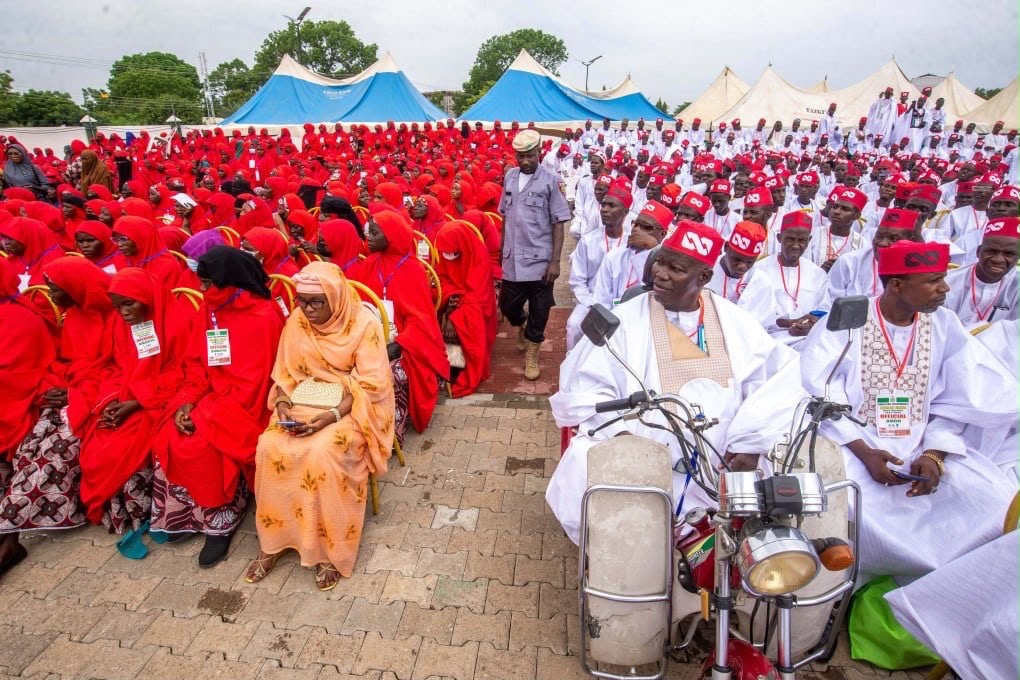
The photographs are colourful. The ceremony is grand. The couples are smiling. Government officials are celebrating. The rhetoric is about family, morality, social stability and helping poor people overcome the rising cost of marriage.
But beneath the spectacle is a much more uncomfortable question: what exactly is Kano State building with ₦1.5 billion?
The Kano State Government has funded the mass wedding of 1,500 couples, with the programme reportedly costing about ₦1.5 billion. The state says the initiative is designed to support vulnerable residents, including widows, divorcees and low-income people. Each couple is to receive a package involving dowry support, household items, food and financial assistance. The programme also includes medical and premarital screening.
On the surface, this sounds compassionate.
Government helping poor people marry is not inherently absurd. Marriage is expensive in Nigeria, and poverty can make starting a household extraordinarily difficult. Some of the beneficiaries are genuinely vulnerable. One of the men who participated this year reportedly lost his wife and six children in a January 2026 attack. For someone in that position, government assistance is not a political joke. It is a lifeline.
But public policy cannot be judged solely by the emotion attached to its beneficiaries.
It must also be judged by what happens after the photographs disappear.
And this is where Kano’s mass wedding becomes difficult to defend.
The government is subsidising households in a society already struggling to build the human capital those households will produce
Nigeria is not suffering from a shortage of people.
The World Bank puts Nigeria’s 2025 population at about 237.5 million, with annual population growth of roughly 2.1 percent. The Bank also estimates that about 3.5 million people enter the Nigerian labour force every year, while the country continues to struggle to generate enough productive employment.
That is the fundamental economic question Kano’s wedding spectacle avoids.
Who will educate the children?
Who will employ them?
Who will provide the electricity, roads, hospitals, classrooms and industries required to support them?
What happens when today’s newly married couples begin having children in a state already struggling with educational deprivation and poverty?
These are not abstract questions.
UNICEF describes Nigeria’s education crisis as enormous. About 10.2 million primary-school-age children and another 8.1 million junior-secondary-age children were out of school according to figures cited by the organisation in 2024. UNICEF also says that northern Nigeria has particularly poor school attendance, with economic barriers and socio-cultural practices contributing to educational exclusion.
Kano itself has confronted the scale of this problem. UNICEF has previously described Kano as having more than 7.7 million children under the age of 15, while local education authorities have reported extremely large numbers of children outside the formal school system.
So there is something almost backwards about the sequencing of priorities.
The state is helping people establish more families.
But the state is not demonstrating anything remotely comparable in building the schools, industries, jobs, healthcare systems and social infrastructure required to absorb the next generation.
That is not family policy.
That is demographic policy without an economic plan.
A wedding is one day. A child is a twenty-year public obligation.
This is the point politicians routinely avoid.
A ₦1.5 billion wedding programme is easy to photograph because its benefits are immediate and visible. A classroom is less glamorous. A vocational school does not generate the same political spectacle. A functioning industrial park is difficult to put into a campaign video. A programme that keeps 100,000 girls in school for another five years does not produce a single afternoon of television-friendly celebration.
But those are the investments that determine whether today’s children become tomorrow’s productive citizens.
Marriage is not the end of a social intervention.
It is the beginning of a chain of obligations.
Every new household potentially produces children. Those children require nutrition, vaccination, education, healthcare, security and eventually employment. If the state cannot provide those foundations, the consequences do not disappear. They accumulate.
This is precisely why population growth without corresponding economic transformation can become a development trap.
The World Bank warned years ago that Nigeria would need between 40 and 50 million additional jobs between 2010 and 2030 simply to keep pace with demographic pressures. It also found that northern Nigeria faced particularly high levels of youth underemployment and lower access to education.
The problem is not that Nigerians are having children.
The problem is that the Nigerian state is producing children faster than it is producing the conditions under which those children can become productive adults.
Kano’s programme does nothing to solve that contradiction.
And then there is the 17-year-old problem
Some of the videos circulating from the ceremony have made the programme even more disturbing.
One widely discussed video appears to show a groom announcing that he has married a 17-year-old girl. That particular claim should be independently verified rather than treated as established fact simply because it has gone viral.
But the fact that such footage has generated such intense concern is itself significant.
Child marriage is not some imaginary problem imported into the discussion by social media critics. It is a documented problem across parts of northern Nigeria. Reuters reported in 2024, during controversy over another proposed mass wedding in Niger State, that child marriage remains prevalent in northern Nigeria and that the official marriage age under federal law is 18, although legal complications arise from differing state frameworks and customary or religious practices.
Kano should therefore be held to a much higher standard.
If public money is being used to facilitate marriages, the state has a special responsibility to demonstrate that every participant is an adult, has freely consented and understands the obligations involved.
Medical screening is not enough.
Genotype compatibility is important.
HIV testing is important.
Pregnancy testing is important.
But the most important screening should be whether the people being married are adults who actually possess the capacity and freedom to make the decision.
A state that can screen thousands of people for genotype should be capable of establishing, transparently and beyond dispute, the age and consent of every participant.
The irony of the Almajiri question
This is where the debate becomes uncomfortable.
The Almajiri system is not itself synonymous with criminality. Islamic scholarship and traditional Qur’anic education have a long history in northern Nigeria. The problem is what happens when religious education becomes disconnected from basic literacy, modern skills, economic opportunity and parental responsibility.
That distinction matters.
Because the real danger is not that every child born to these couples will become an almajiri, a bandit or a street beggar.
That would be lazy and intellectually dishonest.
The danger is that a government can reproduce the conditions that make mass vulnerability possible.
If poor households are encouraged or assisted to form families but their children subsequently grow up without adequate education, healthcare, nutrition, skills or economic opportunities, the state has not solved poverty.
It has reproduced it.
And reproduced poverty becomes a larger social problem with every generation.
UNICEF’s assessment of Nigeria’s children is stark: nearly 105 million Nigerians aged 0 to 17 constitute roughly half of the country’s population, while poverty, inadequate education, poor nutrition and violence remain major threats to children’s development.
That should be the centre of this conversation.
Not whether a wedding photograph looks beautiful.
Not whether the couples received beds.
Not whether politicians wore matching caps.
The question should be whether the government is creating families that can actually escape poverty.
The political symbolism surrounding the ceremony has made the spectacle even more difficult to separate from politics.
Videos circulating from the event showing attendees wearing caps carrying the insignia associated with President Bola Tinubu have understandably provoked criticism.
A government-sponsored wedding is already an exercise in political theatre when public officials place themselves at the centre of an intimate social institution. When participants are visibly surrounded by political branding, the line between welfare and political mobilisation becomes even blurrier.
Public assistance should not require political choreography.
If government gives a poor family a bed, it should not need to turn the bed into a billboard.
If government helps a widow remarry, the widow’s gratitude should not become political merchandise.
If taxpayers are funding the intervention, the beneficiaries are citizens, not campaign props.
This is especially important in Nigeria, where welfare programmes frequently become opportunities for political visibility rather than durable social transformation.
₦1.5 billion is not pocket change
The state has every right to spend money on social protection.
But social protection should reduce vulnerability, not merely make poverty more comfortable for one afternoon.
The reported ₦1.5 billion allocation works out to roughly ₦1 million per couple.
That is a substantial amount of money.
The government’s own reported package includes dowry support, empowerment funding, furniture, food and other household items.
The question, therefore, is not simply: Why did Kano spend money helping poor people marry?
The better question is:
Why is this the form of poverty reduction the government chose to scale?
For the same broad social objective, government could have invested more aggressively in girls’ education, vocational training, maternal healthcare, family planning, agricultural productivity, apprenticeships, small-scale manufacturing, school feeding and youth employment.
Indeed, a recent report examining Kano’s budgetary priorities noted that the ₦1.5 billion mass-wedding allocation dwarfed a reported ₦135 million allocation for interventions aimed at out-of-school and married adolescent girls.
That comparison should make policymakers uncomfortable.
Because if the government truly wants stronger families, the most effective intervention may not be getting people married.
It may be keeping girls in school.
It may be giving young men skills.
It may be helping women earn independent incomes.
It may be ensuring children can read before they leave primary school.
It may be making contraception and reproductive healthcare accessible.
It may be building industries capable of employing the children who are not yet born.
That is what serious family policy looks like.
Kano needs fewer spectacles and more systems
There is a legitimate argument that excessive wedding expenses prevent poor Nigerians from marrying.
Fine.
Then attack the wedding economy.
Reduce unnecessary ceremonial costs.
Provide targeted grants to genuinely vulnerable households.
Create employment.
Expand vocational education.
Offer premarital counselling.
Provide reproductive-health information.
Support young women to remain in school.
Help couples establish sustainable livelihoods.
But do not confuse the ceremony with the policy.
A government cannot marry 1,500 couples and declare victory over poverty.
It cannot distribute beds and declare victory over unemployment.
It cannot distribute dowries and declare victory over family instability.
And it certainly cannot assume that putting two economically vulnerable people under the same roof automatically creates a stable household.
Marriage does not manufacture prosperity.
Productive work does.
Education does.
Healthcare does.
Infrastructure does.
Industrialisation does.
Good institutions do.
The most damning question for Kano is therefore not whether ₦1.5 billion was spent on a wedding.
It is what ₦1.5 billion could have built if the state had approached the problem from the other end.
Imagine the political symbolism of 1,500 couples receiving vocational training instead of merely household furniture.
Imagine 1,500 women receiving businesses with proper market access.
Imagine thousands of children receiving scholarships.
Imagine dozens of functional schools.
Imagine an industrial cluster employing young people whose parents currently survive through informal work.
Imagine a family policy that says: have children, but the state will make sure those children can read, eat, learn, work and build something.
That is the social contract Kano should be pursuing.
Because Nigeria’s demographic challenge is not solved by preventing people from marrying.
It is solved by making sure that every additional Nigerian born has a reasonable chance of becoming an educated, healthy and economically productive citizen.
Otherwise, the government risks building a conveyor belt.
Today, it is a wedding ceremony.
Tomorrow, it is children.
Then classrooms that cannot accommodate them.
Then young people without jobs.
Then households trapped in poverty.
Then another generation pushed toward begging, informal survival, political thuggery, criminal networks or extremist recruiters.
And somewhere down the road, another politician will organise another ceremony and call it empowerment.
That is the cycle Nigeria must break.
The most dangerous thing about Kano’s mass wedding is therefore not that the government helped people get married.
It is that the state appears far more interested in producing the photograph of a functioning society than in building the institutions that make a functioning society possible.
A government should not merely help people start families.
It should build a society in which those families have somewhere to go.
Otherwise, the wedding is not the beginning of prosperity.
It is simply the beginning of another demographic bill that somebody else will have to pay.