
Reviewed By Adeleke Babatunde
by Aremo Yusuf Alabi Balogun (Aremo Gemini)
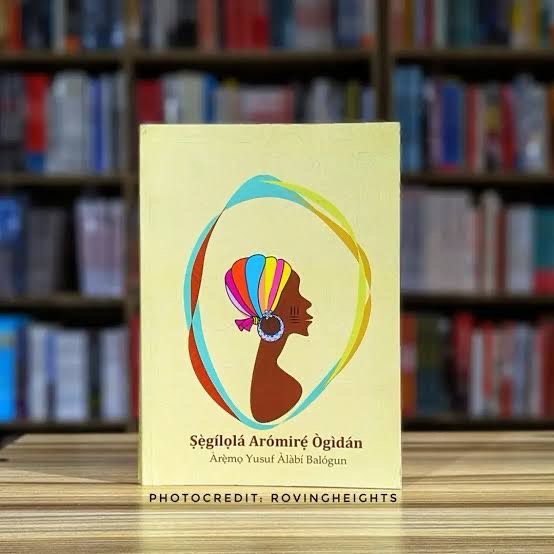
Self- Published 2023, distributed by Rovingheights Books | 370 pages | Written in Yoruba
There is a particular weight that comes with writing about a book whose very existence is the argument. Aremo Yusuf Alabi Balogun’s debut novel Segilola Aromire Ogidan does not simply tell a story. It stakes a claim. It insists, by the mere fact of its 370 pages of living, breathing, contemporary Yoruba prose, that the language of Fagunwa and Tutuola is not a relic. It is not the property of the aged. It is not a museum exhibit or a school punishment. It is a vehicle capable of carrying the ugliest truths of modern Nigerian life: misogyny, sexual exploitation, greed, betrayal, and the spiritual reckoning that follows when people choose ambition over conscience.
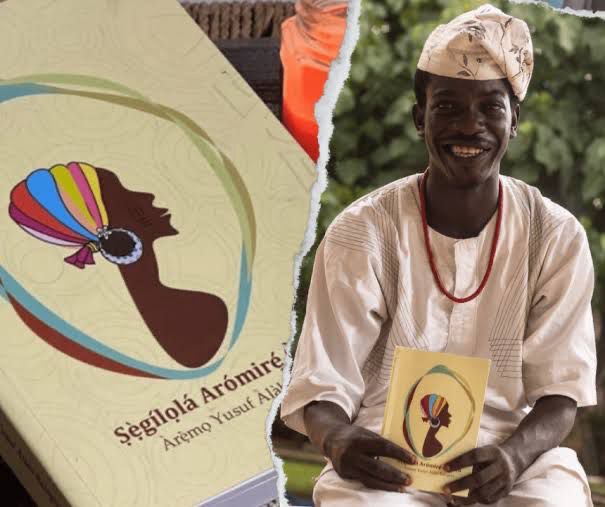
Gemini is primarily known as an experimental performance poet and cultural advocate, a man who has built his artistic identity around the preservation and propagation of Yoruba language and heritage, one who dared to imagine selling out London’s O2 Arena for Yoruba oral arts and has not stopped moving toward that vision. SAO, as the novel is widely known, is both the inevitable result of that artistic conviction and a genuine literary surprise. A debut novel written in undiluted Yoruba, by a self-taught writer who did not attend tertiary institution, that manages to construct a multi-threaded narrative of this density and moral urgency. It is an uncomfortable reminder to a publishing industry overwhelmingly structured around English-language output that literature does not require colonial permission to be excellent.
This review will go deep. Because Segilola Aromire Ogidan demands it.
I. The Landscape This Book Enters
To understand what Segilola Aromire Ogidan is doing and why it matters, you cannot ignore what it walks into. Daniel Olorunfemi Fagunwa, the titan of Yoruba prose fiction, died in 1963. The novels he left behind, Ogboju Ode ninu igbo Olodumare, Ireke Onibudo, Aditu Olodumare, and the others, defined an entire tradition of storytelling that drew from Yoruba oral tradition, Ifa poetry, folktale, and the epic mode. They were carnivalesque, morally charged, cosmologically rich. They were the Yoruba literary universe.
In the six decades since Fagunwa’s death, that universe has contracted. Not because the stories ran out. Not because the language failed. But because the structures that validate, distribute, and fund literature, from publishing houses to school curricula to prize culture, all migrated decisively to English. A generation of Nigerian writers achieved global recognition writing in English. The literary prestige of Achebe, Soyinka, Adichie, Teju Cole was built in a language that could travel through the Booker system, through American MFA programs, through Paris Review interviews. Yoruba prose fiction, however rich, was locked out of that network.
Gemini names this problem directly. He has called for decolonisation in the education system to cultivate greater appreciation of indigenous languages. He has spoken about the difficulty of getting Yoruba novels into stores, about the shortage of capable editors for indigenous-language works. He is not a man who romanticises struggle. He identifies its structural sources. SAO is therefore not simply a novel. It is a provocation addressed at that whole system.
Placing the book in this context is not the same as forgiving its weaknesses or inflating its strengths. It is simply insisting that aesthetic evaluation has to reckon with the conditions under which a work is made. A debut novelist writing in a language the publishing infrastructure has largely abandoned, without the editorial apparatus and developmental support available to English-language writers, who still manages to produce a 370-page psychologically layered, structurally ambitious novel has done something that deserves honest engagement on its own terms.
II. The Story: What Actually Happens
Segilola Aromire Ogidan opens in media res, which is an important structural choice. We meet Segilola, a musician, on her way to meet Chief Kanran Agedegudu, a wealthy patron who has promised to advance her music career through his connections. The price he demands is what powerful men have always demanded from women in need: her body. What Segilola does not know at this point is that her mother has placed Magun on her daughter.
Magun is the Yoruba spiritual sanction against sexual transgression. Broadly described in English as ‘thunderbolt,’ it is a charm believed to activate fatally or physically disablingly against a man who has sexual intercourse with a woman on whom it has been placed without her knowledge. The theology of Magun is complicated. It is simultaneously a patriarchal instrument of female sexual control, used historically to discipline or ‘protect’ women without their consent, and in Gemini’s hands, it becomes something more ambiguous: an act of maternal desperation, a mother’s last resort against a world that will devour her daughter if nothing stops it.
Chief Kanran dies during the encounter. And here is where the story explodes into multiple directions. Segilola, panicked and complicit by proximity if not by direct action, flees. Her fiance, Gbenga Akinrinade, the man she loves with a devotion that the novel watches with increasing horror, turns out to be less interested in her welfare than in the three million naira that Chief Kanran had on his person. Gbenga hears the news, calculates the opportunity, and begins to manoeuvre.
From this central collision of bodies and motives, Gemini builds outward with impressive structural confidence. The novel is 15 chapters, but it operates like a crime thriller, a domestic tragedy, and a moral fable simultaneously. Multiple characters carry weight: Afolake, a woman who has been serially abused by men and has hardened into a kind of bruised vigilante; Bewaji, Chief Kanran’s own daughter, carrying a secret about her father’s death that transforms the story’s moral geometry; Lateef, a man whose family secret intertwines with Sergeant Bimbo’s impossible choice between justice and love; Gberin, who is murdered; and Segilola’s mother, who stands at the story’s quiet, aching centre.
The novel eventually takes Segilola to Ilorin in Kwara State, where she is hiding from the Lagos police who now want her for Chief Kanran’s death. There she is abducted by a faction led by Gbenga and Bewaji. The revelation of who actually betrayed her to the police, and why, is the novel’s most emotionally devastating moment. It is the kind of plot turn that earns its devastation because Gemini has spent the preceding chapters making you believe it could not possibly happen.
III. Character: The Moral Architecture of the Novel
Segilola Herself
The protagonist is one of the more complex female characters in recent Yoruba fiction, and understanding her complexity is the key to understanding what the novel is actually doing thematically. She is not a victim in the simple sense. She makes choices. Several of those choices are infuriating. Readers across existing reviews have expressed a mixture of anger and pity toward her, anger at her loyalty to Gbenga even after his cruelty becomes impossible to deny, pity at the societal conditioning that makes that loyalty feel rational to her.
The anger is legitimate but it is also the point. Gemini is not writing a character study of a woman who fails to see clearly. He is writing a structural indictment of a world that makes poor vision rational. Segilola’s love for Gbenga is not stupidity. It is the product of a woman who has been taught that a man’s presence is security, that his ambition is her opportunity, that her worth is measured by her proximity to male power. When that man turns out to be an opportunist willing to sell her to the police for tactical advantage, the horror is not that she is surprised. The horror is that the system that made her vulnerable to this man was never designed to protect her.
There is a scene, much discussed among readers, where Segilola is in Rayiys’s house and makes a request that leaves readers stunned. Gemini is deliberately withholding in how he stages this moment, making the reader’s own projections part of the experience. The ambiguity is structural, not accidental. Gemini understands that the most truthful statement about abusive devotion is one that makes you uncertain whether you are watching self-destruction or self-determination.
Gbenga Akinrinade: The Anatomy of an Ordinary Villain
Gbenga is one of the novel’s great achievements and also the character who will most clearly divide readers. He is not a monster in the operatic sense. He is not sadistic or deranged. He is simply a man for whom ambition has crowded out conscience so completely that he can no longer see the difference between a person and a resource. He loves Segilola in the way that people love things they want to keep while also being willing to destroy them.
When Chief Kanran makes his demand of Segilola, Gbenga’s response is the most chilling moment in the novel’s early chapters. He sees nothing wrong with it, as long as the music career materialises. His calculation is not even cynical in its own frame of reference. It is practical. It is Lagos logic, career-first logic, the logic of a man who has decided that a woman’s body is a legitimate negotiating chip as long as he is the one doing the negotiating. Gemini makes this point without melodrama. The horror is in the understatement.
Gbenga’s arc toward outright villainy is paced carefully. The escalation feels earned. By the novel’s later stages, when his manipulation becomes predatory and deliberate, the reader has watched every step of how a man convinces himself that each compromise was reasonable. This is a portrait of how misogyny usually works in life: not as sudden monstrous revelation but as a series of small concessions to the idea that a woman’s needs are less real than a man’s ambition.
The Women at the Margins: Afolake, Bewaji, Gberin and the Mothers
Gemini is particularly attentive to what happens to women in the story’s secondary orbits. Afolake is the character whose rage most clearly functions as the novel’s emotional pressure valve. Having been broken by men across her life, she has constructed a posture of inverted aggression, perpetually taking vengeance on the male sex for what some members of it did to her. Gemini does not romanticise this. Afolake’s revenge logic leads her into its own moral compromises. But he does honour the origin of her anger. The reader is never allowed to dismiss her as simply difficult or unstable, because the text has made the architecture of her damage visible.
Bewaji carries what is perhaps the novel’s most structurally significant secret: her own instrumentality in her father’s death. The confession, when it comes, reframes everything the reader has understood about Chief Kanran and about the women in his world. It also complicates the novel’s use of justice. Gemini is asking who deserves to grieve, who deserves to be angry, and whether the truth is ever simple enough to produce clean verdicts.
Segilola’s mother is the novel’s most emotionally devastating presence and arguably its moral anchor, which is interesting because she is the character who arguably initiates the novel’s catastrophe by placing Magun on her daughter. Gemini asks the reader to hold two truths simultaneously: that her action was a violation of her daughter’s bodily autonomy, and that it was an act of love from a woman who understood, with the clarity of experience, what Chief Kanran was and what would happen to Segilola without intervention. That the intervention did not save her in the end is the novel’s quiet tragedy.
IV. Language and Style: Writing in Ijinle Yoruba
The linguistic dimension of SAO cannot be reviewed as a secondary consideration. It is the primary aesthetic event of the book.
Gemini writes in what is described as ijinle Yoruba, deep Yoruba, a register that deploys proverbs, idioms, coded speech, and the full tonal and lexical range of the language rather than the flattened, simplified version that has become common in everyday use and in the increasingly thin literary tradition. For readers who grew up speaking Yoruba at home but consuming most of their fiction in English, reading SAO is an experience with a specific texture. Several reviewers have described it as like drinking fresh water, as a return to something they did not know they had been missing.
The use of owe (proverbs) throughout the narrative is not decorative. Proverbs in Yoruba discourse function as compressed philosophical claims, small systems of wisdom that the speaker invokes to authorise or contextualise what they are saying. When Gemini deploys a proverb at a moment of narrative crisis, he is not adding colour. He is triangulating the event against the accumulated moral knowledge of the culture, asking the reader to measure what is happening against what the ancestors understood about how things go wrong. This is how Yoruba oral literature has always worked. Gemini is doing in prose what the griot does in performance.
The closing chapter, titled ‘Ferese Aye’ (Window of the World), contains a meditation on the restlessness of human beings both in life and in death, the vanity of what we chase, and the nature of trial as the condition of existence. This passage reads in a register close to poetry. The fact that it closes a crime thriller speaks to what Gemini is attempting: genre fiction that carries the weight of classical Yoruba moral philosophy.
Eniyan sha. E ki i fun ara yin ni isinmi, nigba ti e ba wa laye. Nigba ti e ba tun ku tan, e ko tun ni fun ara yin ni isinmi. Aaarin aye ti emi ati Talib n gbe yii, ti fi ye mi pe lasan ni gbogbo nnkan ti omo eniyan n wa kiri.
People, indeed. You do not give yourselves rest while you are alive. When you die, you still give yourselves no rest. The middle of this world that I and Talib inhabit has revealed to me that all the things human beings chase are vanity.
This is the register Gemini is working in throughout. His characters speak with the density of people who understand that their actions carry spiritual resonance, that what they do to each other is measured by something beyond immediate consequence. The tone is never preachy. It is simply inhabited.
On the Accessibility Question
A legitimate critical question is whether the depth of Gemini’s Yoruba is an asset or a limitation. Readers for whom Yoruba is primarily a spoken home language rather than a language they read regularly will find sections demanding. This is not a flaw. It is a deliberate positioning. Gemini has said clearly that his art requires keenness, that the gems are locked within and that you must love the language to find them. This is not elitism. It is the refusal to simplify. The Yoruba literary tradition at its height was never simple. Fagunwa was not easy. Depth was the point.
What this means for the novel’s reach is real and worth naming honestly. SAO will find its most complete readers among those with genuine Yoruba literacy. This limits the book’s immediate commercial appeal in a literary marketplace that privileges accessibility. Gemini knows this. He has chosen depth anyway. That is a stance, not a mistake.
V. Thematic Dissection
Misogyny as Architecture, Not Event
The most important thematic achievement of SAO is that it refuses to treat misogyny as a series of bad individual choices. It presents it as an architecture, a system in which women are structurally positioned as resources rather than persons, and in which that positioning is maintained not only by the men who exploit it directly but by the cultural assumptions that make those men feel entirely reasonable.
Chief Kanran is not a villain the reader can comfortably externalise. He is a man operating within a well-established transactional logic, the logic that says powerful men have access to women who need what only powerful men can provide. This logic is not aberrant in the world of the novel. It is the water everyone swims in. Gbenga endorses it. The music industry structure enables it. The silence around it, the shared understanding that this is simply how careers are advanced, makes it normal.
Gemini’s gender politics are not separatist or abstract. They emerge from specific characters in specific situations, and they accumulate into a picture of how ordinary social arrangements produce extraordinary harm. He is clearly a writer who has thought long and hard about the mechanics of gendered oppression, and the result is a novel in which no reader can locate themselves comfortably outside the problem.
Magun: Mystical Justice and Its Complications
The deployment of Magun as a narrative engine is the novel’s most culturally specific and most intellectually risky move. Gemini enters a long-contested space. Magun has been debated for generations: is it real? Is it a patriarchal superstition designed to control female sexuality? Is it a spiritual reality that the modernist mind cannot accommodate? Gemini does not resolve this debate. He uses the ambiguity.
What matters narratively is not whether Magun is empirically real but what its presence means in the moral economy of the novel. A mother, operating at the limits of her power to protect her daughter in a world that will not protect her otherwise, reaches for the only tool she has. That tool is embedded in a cultural tradition that is itself patriarchal in its origins. The mother turns a patriarchal instrument against patriarchal exploitation. This is not clean. Gemini does not make it clean. The daughter does not consent to being protected this way. The protection produces a death. The death produces a hunt. The hunt destroys the family.
Gemini is asking a question that Nigerian society needs to ask more openly: when the law fails women, when the family fails women, when the economy fails women, what is left? And what happens to the moral clarity of the person who reaches for whatever is left?
Karma, Consequence and the Refusal of Easy Justice
The novel is structured around consequences. Every character’s actions rebound in ways they did not anticipate. Adewusi, the police officer who abets criminals, loses his five children to a school building collapse. Gemini uses this to make a philosophical point: the rot is structural. The officer’s corruption is not an individual moral failure in isolation. It is a link in a chain of institutional failure whose costs are borne by people who had no part in creating it.
This is not the simple karma-rewards-the-good theology of much popular fiction. It is something more like tragic fatalism with political consciousness. The world of SAO is one in which bad choices radiate outward with terrible efficiency, contaminating the innocent. No one is saved simply by being virtuous. Segilola is genuinely sinned against by almost everyone around her, and the novel does not spare her suffering on account of it.
The Reincarnation Frame and Yoruba Cosmology
The novel makes use of the Yoruba belief that people who die premature or violent deaths may return to another location to continue living. This is not supernatural decoration. It is cosmological architecture. The idea that death is not a terminus but a transition, that the dead are still owed something by the living, that unresolved business survives the grave, is central to how the novel’s universe operates.
Gemini is one of the few contemporary Yoruba-language authors to integrate this cosmology into a modern crime narrative without rendering it as mere superstition or reducing it to plot mechanism. The spiritual dimension of SAO is handled with the same seriousness as the social dimension. Misogyny is a social problem and a spiritual one. Betrayal has social consequences and spiritual ones. The novel holds these registers together without apology.
VI. The Craft: Structure, Pacing, and the Web of Chaos
Gemini has described his narrative design in SAO as a web of chaos, one that begins when the story seems to end. This is an accurate self-description. The novel’s structural logic is cumulative and radial rather than linear. Each chapter does not simply advance the plot. It adds a new node to a network of relationships and secrets whose full shape only becomes visible in retrospect.
The 15-chapter structure is well-judged. It gives Gemini enough space to develop secondary characters without losing narrative momentum. The escalation of climax from chapter to chapter is genuine. Each time the reader settles into what seems like the novel’s central conflict, a new development unsettles that settlement. This is not manipulation for its own sake. It mirrors the actual experience of being caught in a network of other people’s choices and secrets: you never know which door conceals the next shock.
The pacing of information release is one of Gemini’s most accomplished skills. He withholds with precision. The secret of who betrayed Segilola to the police is held back long enough that when it arrives, the impact is maximum. The revelation of Bewaji’s secret reframes the entire novel’s understanding of justice and grief. These are not twists in the thriller-mechanic sense. They are moral revelations. The information changes not just what happened but what it means.
Where the structure occasionally strains is in the management of its many threads. A novel this densely populated, with characters moving across Lagos, Abeokuta, and Ilorin, with spiritual, criminal, romantic, and familial storylines all running simultaneously, requires extraordinary discipline. Gemini largely maintains that discipline, but there are moments where a reader without perfect recall of earlier chapters will need to reconstruct connections. The reward for patient attention is substantial; the demand is real.
VII. The Author: Who Is Aremo Gemini and Why Does It Matter?
Yusuf Alabi Balogun grew up in Ijora, a Lagos neighbourhood with a reputation for danger, the kind of place that provides its young residents with a comprehensive education in how precarious life can be. His early exposure to moonlight stories from his mother, his discovery of Yoruba oral performance, his decision to build an artistic career without the institutional scaffolding of tertiary education, all of these are not incidental biographical details. They are the conditions that produced a novelist whose instincts are those of a griot rather than a scholar.
He was trained by the stage, which is to say he learned how to hold an audience by holding actual audiences, at Wordaholics open mics, at FUNAAB, UNILAG, OAU, UI, LASU, at Felabration and Ake Arts and Book Festival. By the time he wrote SAO, he understood pacing and revelation and the management of emotional energy not as abstract craft principles but as survival skills. A performer who cannot hold a crowd loses it. That discipline is visible in the novel.
The death of his father in September 2020 is cited by Gemini himself as a turning point. It gave him a map for what he wanted to do and be. His second novel, Isepe, published in October 2025, emerges from that grief more directly, channelling his mother’s experience of societal subjugation and resilience into a narrative about widowhood, black tax, domestic abuse, and the culture of silence. That SAO, published in 2023, also carries the weight of that biographical moment without making it explicit is testimony to how thoroughly Gemini has sublimated personal experience into structural design.
The launch of Jomitoro, a Yoruba podcast modelled as a dialogue between Gemini and his mother in May 2025, is consistent with the sensibility visible in SAO: the belief that cultural transmission is an act of care, that the voices of storytelling elders deserve preservation not as artefact but as living conversation. The podcast and the novel are two expressions of the same project.
VIII. SAO in the Larger Context of Yoruba Literature
The comparison that surfaces most readily in discussing SAO is Buchi Emecheta’s The Joys of Motherhood, which itself was a novel about the specific suffering of women within patriarchal African family structures, the ways motherhood is simultaneously valorised and weaponised against women. One reviewer invoked this comparison unprompted. It is apt because both novels refuse sentimentality about the family as a site of safety.
But the more urgent comparison is to the Fagunwa tradition itself. Gemini is not writing in Fagunwa’s mode: SAO is not a forest odyssey, it does not use the allegorical frame of the hero quest, it does not traffic in the same cosmological grandeur. What it inherits from Fagunwa is the conviction that Yoruba prose can carry complexity without simplification, can honour the full resources of the language while telling a story that grips from first page to last. That inheritance is enough.
It is also worth placing SAO alongside the broader contemporary literary moment in Nigeria. The last decade has seen Nigerian literature in English achieve extraordinary international visibility. This visibility has been won in a language that can travel through the prize economy of the English-speaking world. SAO cannot travel that road. It is written in a language that has no Booker, no Pulitzer, no international prize infrastructure. Gemini has staked his work on a different kind of longevity: the permanence of a culture’s relationship to its own language. He is betting that that permanence outlasts prize cycles. He is probably right. And the book is now a front line contender for the best thriller book at the African Laureate Awards.
IX. Honest Assessment: What the Novel Is and What It Is Not
Segilola Aromire Ogidan is not a flawless novel. The density of its character ensemble, while a genuine structural achievement, means that some secondary figures are thinner than others. In a work this explicitly concerned with the inner lives of women, a few of the male antagonists could use more interior texture rather than functioning primarily as drivers of plot. The novel earns its moral conclusions, but there are places where the path to those conclusions is slightly overcrowded.
There is also the question of editorial support. Gemini noted publicly the challenge of finding capable editors for Yoruba-language works. This is not an accusation. It is an acknowledgment of an infrastructural gap that affects the whole tradition, not just this novel. What SAO achieves without the editorial infrastructure available to comparable English-language fiction is remarkable. What it might have been with that infrastructure is a question the culture should be asking itself.
None of this diminishes the core achievement. SAO is a work of genuine literary ambition that succeeds on its own terms. It tells a story of moral complexity without simplifying it. It uses the Yoruba language with depth and deliberateness. It builds characters who live after the last page. It asks hard questions about power, gender, betrayal, and the spiritual cost of choosing ambition over conscience, and it does not answer them cheaply.
Segilola Aromire Ogidan is Self- published, distributed by Rovingheights Books and available for global purchase at rhbooks.com.ng.
Aremo Yusuf Alabi Balogun’s sophomore novel, Isepe, was published October 2025.
Segilola Aromire Ogidan: A Review |
But