
Babatunde Adeleke
Love and Antidote
By Jide Badmus
Jide Badmus distills love into micro-poems that bite, mourn, celebrate and finally unsettle, in a chapbook that announces a poet fully in command of compression.
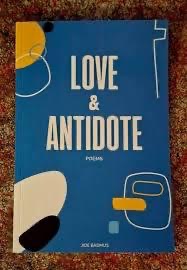
There is a particular kind of courage in brevity. To say everything in four lines, to risk looking slight while meaning profound, demands not just craft but nerve. Jide Badmus, the Nottingham-based Nigerian poet, editor, and founder of the literary community INKspiredng, has that nerve in abundance. His new chapbook, Love and Antidote, arrives as a sequence of micro-poems about romantic love, arranged in two movements, and concludes with a flash fiction piece that reframes everything that came before it with unsettling force. The result is one of the more genuinely surprising poetry collections to land this year.

Badmus, who has authored four poetry collections and seven chapbooks, is not a poet who wastes your time. It is one of the many reasons I love him and his works; I have read everything he has published and yes, that is a flex!
These poems are micro-poems, some barely four lines long, yet they carry the emotional density of pieces five times their length. The opening epigraph poem, set before the table of contents, frames the collection immediately: love as a cold pint on a hot noon, as jukebox music animating the body. It is a blues image, loose and sensory, and it sets a tone of pleasured disorientation that holds for the entire first chapter.
“Altitude is metaphor / for consciousness / When we fall in love, / we fall asleep” — the whole chapbook distilled into four lines.
The blurb by poet Beth Brooke gets the book right when it describes the collection as one that makes the reader feel as though in conversation with the poet. That is precisely it. These are not monolithic meditations delivered from a great height. They are dispatches, observations, confessions. They have the feel of something overheard and then written down very quickly before it could be lost. That quality of urgency, married to formal precision, is the animating tension of the collection.
IMAGERY AND METAPHOR
The chapbook’s central strength is its metaphorical imagination, which is both wide-ranging and culturally grounded. Badmus draws from an impressively eclectic storehouse: maritime navigation, digital technology, West African music, Nigerian street culture, religious iconography, and romantic mythology all make appearances. In Love and Strings, a man in love is rendered as a wild kite, tossed on air currents and controlled by forces beyond himself. In Love and Maritime, the heart dreams as broadly as oceans while passion acts as a mast luring the speaker toward offshore treasure. The poem closes with a declaration that love cannot be kept anchored to harbour, an image that doubles as both nautical fact and emotional truth. This kind of layering, where the literal and figurative operate simultaneously, is Badmus at his most confident.
Perhaps the most culturally textured poem in the collection is Love and Ogogoro, which borrows its title from the potent Nigerian palm spirit. To be in love, the poem argues, is to befriend insobriety, to court heartbreaks and hangovers with equal willingness. The comparison is not merely witty; it captures something real about the loss of rational control that love enacts. And it does so with a specificity that grounds the poem firmly in West African experience, even as its emotional logic translates universally. This is the collection’s recurring trick: the locally specific as a vehicle for the broadly human.
Love and Corruption, dedicated to Linda, turns the lexicon of cybersecurity into love poetry. The beloved’s smile is described as a trojan that grants access to the speaker’s innermost self. His sanity is looted; his passcodes surrendered. The poem is wry, self-aware, and genuinely funny in the way the best love poems sometimes are. It is also astute about vulnerability. Badmus understands that to love someone is to grant them administrative access to everything you are, and he makes that digital metaphor feel not clever but necessary.
Badmus understands that to love someone is to grant another person administrative access to everything you are.
Love and Makossa is the collection’s most sensory poem, cycling through reggae dawns, percussion clouds, brass lips, and the skin of time stretched over love’s drum. The poem names the Congolese and Cameroonian musical form makossa and in doing so anchors the poem in a specific sonic tradition while making it resonate outward. Music here is not decoration but structure: love is a rhythmic phenomenon, something the body learns before the mind does. It is among the collection’s most purely pleasurable pieces.
STRUCTURE AND FORM
The chapbook is divided into two chapters, Love and Antidote, and the structural logic is clean and deliberate. The first half establishes love as a condition: disorienting, vulnerable, metaphor-hungry. The poems are named with a consistent titling pattern, “Love and [Noun],” and this repetition creates a kind of litany effect. Each poem becomes a new angle on the same subject, the way a gem turns to reveal a different facet under light. By the time you reach Love and Antidotes, the title poem at the midpoint of the chapbook, the collection has accumulated enough emotional weight that its pivot into religious imagery, nails, temple curtains, sin and sacrifice, feels earned rather than overwrought.
The title poem itself is the collection’s most formally daring. It moves through nails piercing shadows and curtains splitting, through sin and sacrifice swelling at the altar, to arrive at the speaker racing for redemption down the throat of a holy pit. It is bold, almost reckless, imagery, and in a lesser poet’s hands it might collapse under its own weight. Here it holds, because the poem has something specific to say: that to fall in love is to seek an antidote to death itself by courting it willingly. The collection’s title earns its ambiguity in these eight lines.
The micro-poem format is demanding in a way that is easy to underestimate. When a poem has four lines and no room for error, every word must carry weight. Badmus is mostly equal to this challenge. Love and Gravity declares that falling in love is like falling asleep, that the dreaming mind cannot fight the pull of its own visions. Love and Starvation is even more stripped back: the appetite for the beloved surpasses any other form of nourishment. What is remarkable is that these poems, despite their brevity, do not feel thin. They feel condensed, as if pressure has been applied to turn raw emotion into something harder and more permanent.
CHAPTER TWO: INTIMACY UNPACKED
Where Chapter One tends toward the declarative and philosophical, Chapter Two is warmer, more embodied, and occasionally playful. The epigraph for this section states that a touch communicates more clearly than a thousand love poems. It is a thesis statement for what follows.
Show Time imagines the speaker as a love puppet, his name reeled out in sultry syllables, his heart stretched in adlib, his limbs sent into frenzy. The puppet conceit is comic but also oddly honest; few poems about desire own up so readily to its willing subjugation. The poem does not romanticise powerlessness, but it does humanise it.
Apprentice goes further still. The speaker asks to be gathered up, his knees liquid, his heart still learning how to fall in love. There is something disarming in these admissions, a masculinity that does not require performance, and it gives the second chapter a warmth that the more rhetorical first chapter sometimes withholds. Badmus is good at this: the sudden drop of the guard, the line that arrives without preparation and lands more heavily for it.
Extraverbal is the collection’s most quietly sustained achievement. Two figures pause at the cusp of conscience, shivering like oceans at the touch of wind, seeking language for things without tongue. The poem confesses its own inadequacy and in doing so enacts precisely the condition it describes. Language cannot hold the moment; the poem itself cannot fully render what it gestures toward. That is the point. And it is the point made beautifully.
“Extraverbal” confesses its own inadequacy and in doing so enacts precisely the condition it describes.
Alchemy, just two lines long, completes the thought: stuttering lips find eloquence in a kiss. It is the chapbook’s most economical line and one of its most memorable. After the complexity of Extraverbal, this two-liner feels like both a punchline and a resolution.
Frozen opens the second chapter with warmth arriving after cold, strokes of fire and warm mural thawing both time and emotion. The Pianist renders desire through fingers running over cornrows, setting the heart’s keys alight. GPS is almost braggadocious in its intimacy, the speaker cataloguing his knowledge of the beloved’s body down to every grain and fibre. And yet it does not read as crass; the poem’s confidence comes across as devotion rather than possession.
Equilibrium, a three-liner near the chapter’s close, may be the chapbook’s most economical emotional statement. Life swings like a seesaw; the beloved is the stabilising force. It sounds simple because it is simple, and Badmus is wise enough to leave it alone, to trust that simplicity to do its work. Not every poem needs to perform complexity. Some just need to be true.
The maritime poems of Chapter Two, Horizon, Tide, and Drowning, form a loose triptych that builds toward catastrophe without ever quite reaching it. In Tide, the speaker urges the boat to strip itself bare and let love drive it through a storm of longing to the pier of screams. In Drowning, the world is drowning and the two speakers dance atop it like fiery seaweeds. These poems are at their best when they embrace this slightly unhinged logic: love not as salvation from the world but as a parallel madness pursued alongside it.
CULTURAL GROUNDING AND DICTION
One of the more interesting formal decisions in the chapbook is Badmus’s use of proper nouns and brand names from Nigerian and West African culture alongside globally recognisable references. Ogogoro sits beside makossa; Cupid appears in the same poem as nature. This is not cultural code-switching in the anxious sense; it is the natural vocabulary of a poet who moves between worlds and finds both entirely available to him.
The diction throughout is lean and musical. Badmus has a good ear for sound, and even in the shortest poems there is attention to the weight and texture of individual words. The second chapter’s epigraph, “When you touch me, I hear you / clearer than a thousand love poems,” is a fine example: the shift from touch to hearing, from the tactile to the auditory, creates a small synaesthetic surprise in just two lines.
The collection also includes a section titled “From Skegness with Love,” consisting of photographs of love locks on coastal railings. The photographs are haunting in a quiet way, padlocks rusted by sea air, names weathered into illegibility, the physical residue of declarations that may or may not still hold. As a coda to the lyric poems, they introduce a note of mortality and time that the poems themselves rarely confront directly. Love, the photographs suggest, is also corrosion.
THE FLASH FICTION: A DARK MIRROR
The collection closes not with a poem but a piece of flash fiction, The Vacuum, and this is its most audacious structural move. Written in the second person, a technique that implicates the reader directly, it traces the dissolution of a marriage through absence: an empty fridge, a spouse perpetually at church, intimacy become a lost language. The domestic realism is rendered with restraint and considerable precision.
The second-person narration is a risk that pays off. By positioning the reader as the protagonist, a Lagos business mogul named Segun whose marriage has curdled into a silent standoff, Badmus makes the discomfort inescapable. You cannot read this story at arm’s length. You are the man who stopped listening, who let the conversations lapse, who finds himself alone in a house that feels more like a crypt than a home.
The story’s final turn, where nightmare and waking blur, is genuinely disturbing and entirely deliberate. Badmus does not offer resolution. The final image is of shaky hands reaching again toward a wife who has already once pushed them away. After thirty pages of lyric celebration, love as alchemy, equilibrium, and antidote, Badmus places before us love’s other face: the vacuum left when it empties out.
After thirty pages of lyric celebration, Badmus places before us love’s other face: the vacuum left when it empties out entirely.
It is a structurally bold decision to end a love poetry collection this way, and it works because it is not a repudiation of what came before. The tenderness in the poems is real. So is the wreckage in the story. Both are true. Badmus does not resolve the tension; he holds it, which is the more honest thing to do.
***
Beth Brooke, in her foreword, calls Love and Antidote a keeper. She is right. This is a chapbook that rewards rereading, and not only because the poems are short enough to accommodate it easily. Each piece offers something to reflect upon and, crucially, something to take away: a phrase, an image, a way of naming a feeling that had previously resisted naming.
Badmus is a poet who trusts the reader, which is the foundational virtue of good lyric writing. He does not over-explain. He does not pad. He commits to his images and then gets out of the way. The collection’s best poems, Extraverbal, Love and Maritime, Love and Ogogoro, Apprentice, and Equilibrium, demonstrate a poet at full command of his instrument: knowing exactly how much pressure to apply, exactly when to stop.
Love and Antidote is a disarming, pleasurable, and occasionally unsettling collection. It celebrates love with genuine warmth and refuses to pretend that warmth is the whole story. For a book this short, it contains multitudes. That is no small achievement.