
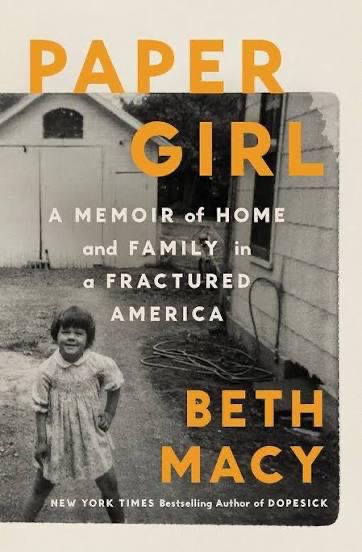
A review of Beth Macy’s A paper Girl
Adeleke Babatunde
There is a particular kind of American nostalgia that begins with a factory whistle.
It remembers a town when the plant was hiring, the newspaper arrived every afternoon, the school band had enough children to spell the name of the school on a football field, and a poor kid could imagine that leaving town was not an escape from America but a way of entering it. In Paper Girl: A Memoir of Home and Family in a Fractured America, Beth Macy returns to Urbana, Ohio, the small town she left more than four decades ago, and discovers that the thing she misses is not exactly the town. It is the machinery of belonging that once existed there.
Macy’s subject is ostensibly the fracture of contemporary America. But her more revealing subject is the disappearance of the ordinary institutions that once absorbed the shocks of poverty, addiction and family dysfunction. Her hometown has not simply become poorer. It has become less capable of catching people when they fall.
That distinction gives Paper Girl its unusual force.
Macy knows the terrain personally. As a child, she grew up with an alcoholic father, an overworked mother and the familiar improvisations of working class survival. She delivered the Urbana Daily Citizen six afternoons a week, pedaling a Huffy ten speed through town and collecting the small debts owed by neighbors. She wanted the money for clothes and for a school trip to Washington, D.C. But the paper route gave her something more valuable: a map of the town. She knew the bankers, teachers, factory workers and widows along her route. The newspaper allowed a poor girl to move through social boundaries that might otherwise have remained invisible.
That is where the title becomes more than autobiography.
The “paper girl” is also a metaphor for journalism itself. Macy grew up in a place where the newspaper helped a community see itself. Decades later, the newspaper has been hollowed out. Local reporting has diminished, leaving residents to understand their neighbors through Facebook posts, press releases and national political narratives. The result is an information vacuum, but also something more intimate: people lose the habit of knowing one another.
This is one of Macy’s sharpest insights. Democracy does not only deteriorate in Congress or at the ballot box. It can begin to deteriorate on a street where nobody knows who lives next door.
The book’s central figure, Silas James, makes that argument painfully concrete.
Silas is the young person Macy sees as the contemporary version of herself. Like Macy, he is bright, poor and determined to make something of himself. Unlike Macy, he comes of age in a far more unforgiving America. He graduates from Urbana High School with scholarships waiting for him at community college and dreams of becoming a welder. He is talented with his hands and sees welding almost as an art. Yet within days of beginning college, his car breaks down and a family emergency pulls him back into the responsibilities of a household that has repeatedly failed to protect him. His education is derailed not by lack of ability but by the mundane infrastructure of poverty: transportation, housing, family instability and the absence of anyone who can reliably absorb a crisis.
It is difficult to imagine a more devastating definition of inequality.
The scholarship exists. The ambition exists. The intelligence exists. The classroom exists.
What is missing is a bridge between them.
Macy is particularly good at showing how small that missing bridge can be. A car that will not start. A bus that does not come. A child who has nowhere stable to sleep. A parent in jail. A scholarship that covers tuition but not transportation. A school bureaucracy that cannot quite figure out where a homeless student belongs because, technically, he has no address. Silas attends seven schools between kindergarten and graduation.
The tragedy is not that Silas lacks a support system. He has one. His teachers, counselors and band director repeatedly intervene on his behalf. One counselor helps arrange his transportation. Another helps secure the paperwork for his financial aid. His band director becomes something between teacher, father figure and emergency counselor. In Silas’s phone, he is saved as “David M. Dadd.”
But these people are performing, individually, the work a functioning society should make easier.
That is perhaps the book’s most unsettling argument: America has not necessarily stopped caring. It has stopped making care sustainable.
The distinction matters because Paper Girl refuses the easy political explanation. Macy does not reduce Urbana’s decline to Donald Trump, globalization, Republicans, Democrats, opioids, social media or the collapse of local journalism. All of these appear in the book, but none is allowed to become the single villain.
Instead, Macy follows the trail backward.
The factories disappeared. Unions weakened. Wages stagnated. Higher education became harder to afford. The safety net narrowed. Addiction moved through families. Schools inherited responsibilities once carried by parents and neighborhoods. Local newspapers shrank. National media filled the vacuum. Social media turned political disagreement into an industry. And eventually people who once knew one another began inhabiting entirely different versions of reality.
The book is at its most intelligent when Macy recognizes that these developments are not separate crises. They are connected.
A declining newspaper and a struggling school are part of the same story. So are the empty factory and the angry Facebook feed.
This is why the book’s treatment of Macy’s own family is so important. Her siblings become, in miniature, the America she is trying to understand. They love one another while increasingly disagreeing about what is true. One sister embraces conspiracy theories and distrust of mainstream journalism. Another relationship becomes strained over politics. Macy discovers that arguments about race, abortion, religion, Donald Trump, vaccines and LGBTQ people are not merely arguments about public affairs. They are arguments occurring inside families whose older emotional bonds are still intact.
There is something almost tragicomic about these scenes because Macy understands that affection and ideology can occupy the same room.
She can disagree with a lifelong friend about George Floyd and still have that friend rub her aching back after a seven hour drive. She can be furious with a sister over what that sister believes about her nephew and still remember the childhood from which they both came. Macy’s great achievement here is resisting the temptation to turn disagreement into moral distance. Her friends and siblings can be wrong, sometimes spectacularly wrong, without becoming fictional villains.
That restraint is crucial.
Macy’s own position is hardly neutral. She is a journalist, a mother of queer children and an observer who is deeply skeptical of the political and cultural claims embraced by some of the people she grew up with. Yet she understands that contempt is a terrible substitute for reporting.
The book is therefore also an argument about journalism.
The reporter’s job, Macy suggests, is not merely to collect facts that confirm what one already believes. It is to remain curious about the people with whom one disagrees long enough to discover the conditions that produced the disagreement.
That is precisely what she does in Urbana.
And sometimes what she discovers is uncomfortable even for her.
The town she remembers as a wholesome factory community was never quite as innocent as memory suggested. Its history contains slavery, abolition, racial violence and a notorious 1897 lynching in which a Black man named Charles “Click” Mitchell was seized from jail and murdered by a mob. The body was displayed in a pine box across from the town’s Civil War monument.
This historical excavation complicates the book’s nostalgia. The America Macy remembers was never a paradise waiting to be recovered. It contained exclusion and cruelty alongside community and opportunity.
That is another of the book’s great corrections.
Macy is not arguing that America used to work perfectly. She is asking why certain mechanisms that made upward mobility possible for an imperfect, unruly girl like her have become so much harder to access for a similarly imperfect, unruly kid forty years later.
Her answer is devastatingly simple: Macy had help she did not know she was receiving.
She had a grandmother nearby. She had teachers who noticed her. She had a mother who, despite her own hardships, kept the household functioning. She had a library. She had a newspaper route. She had a school that assumed education mattered. And, crucially, she came of age when public investment still made it possible for a poor student to leave home for college. Her Pell Grant covered tuition, room, board and textbooks.
Silas inherits almost none of that margin for error.
This is why the book’s title is quietly brilliant. A paper girl is a child moving from house to house, delivering the news. But Macy is also delivering news about what has happened to the house itself.
And the news is not entirely bad.
By the end, Silas has not become the neat success story that a conventional American narrative would demand. He does not simply graduate, get the good job, leave town and transcend his past. He completes his welding certification, wins an award for his work and builds a relationship with Max. He begins working toward management at an auto parts store. He and Max buy a car together and plan to establish a home of their own. Yet his family remains unstable, his younger siblings remain vulnerable and his educational ambitions are postponed.
Macy wisely leaves the victory unfinished.
That may be the book’s most humane decision.
America loves a redemption story because redemption allows the audience to stop worrying. Paper Girl does not offer that comfort. Silas is doing better, but doing better is not the same as being safe. A welding certificate cannot repair a family. A job cannot erase childhood trauma. A functioning car cannot compensate for a society that has made every other part of the journey precarious.
Yet there is hope here, and it comes from a less glamorous place than politics.
People showing up.
A teacher who stays late. A counselor who makes another phone call. A friend who gives a ride. A family that gives a homeless girl a bedroom. A band director who keeps the office open. A woman who takes in a struggling young person simply because, as she puts it, “She needed stability. And we have the space.”
This is why Macy’s mother’s instruction to her becomes the emotional key to the whole book: stop writing sad things. Write a love story.
Macy eventually understands that she has been doing exactly that.
The love story is not a romance. It is the stubborn, imperfect love by which people keep one another alive when institutions fail. It is teachers becoming temporary parents. Friends remaining friends across political lines. Siblings trying, sometimes badly, to remain siblings. A town trying to remember what it once owed its children.
The America in Paper Girl is fractured, but not dead.
Its deepest fracture is not between red and blue. It is between people who still believe they belong to one another and people who have forgotten how belonging works.
Macy’s great achievement is that she never asks us to choose between compassion and accountability. She asks for both. She asks us to understand how people arrived at their convictions without pretending every conviction deserves equal weight. She asks us to look at poverty without romanticizing it, at rural America without caricaturing it, at family without sentimentalizing it, and at journalism without forgetting its failures.
Most of all, she asks us to consider what happens when a society stops raising children collectively and starts telling each child to save himself.
Silas’s story suggests the answer.
Some will.
Many will not.
And the difference may have less to do with character than we have been willing to admit.
Paper Girl begins with a child delivering newspapers through a small Ohio town. It ends up delivering something much larger: an indictment of the American habit of mistaking individual resilience for social health.
The paper girl grew up and became a reporter.
Then she came home to find that the story had changed.
She stayed long enough to listen.