My father bought the album. I don’t remember which year exactly, but I remember the cassette, and I remember the living room, and I remember the specific quality of attention my father paid when he first played it. He wasn’t dancing. He was listening. That was how I knew it was serious.
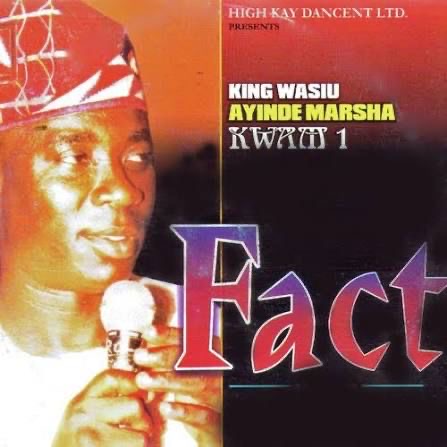
The song was called Fact. And K1 meant every syllable of the title.
He sang in Yoruba, which meant he was talking to us directly, not performing for anyone who needed subtitles or translations or diplomatic softening. He was talking to the Yoruba family in their living room, to the trader who couldn’t keep her goods cold because there was no electricity, to the man who had stood in line and voted in 1999 and was now, a few years later, still standing in the dark. He sang: all that we said in 1999 that made us happy, we cannot see it again. Just like that. No metaphor. No evasion. He named the feeling that millions of Nigerians were carrying but couldn’t quite articulate, that particular flavour of betrayal that comes not from an enemy but from a man you chose.
He went further. There is no food, no electricity, freedom of human rights is wanting. You have to understand what it meant to hear a musician say that plainly, with that directness, in that era. This was not a backroom conversation. This was a record. This was something people would buy and play and sing along to. K1 was putting his name to it, his voice to it, his livelihood to it.
Then he did something that I still think about.
He told President Obasanjo to take a tour of his own country. KWAM 1 said he had just come back from a trip to Ghana, and that for four days, not once did the power go out. Four days. No generator. No candle. No interruption. Just electricity, like it was a normal thing, because in Ghana it was a normal thing. He asked the president: we sent aid to Ghana, we helped that country stand, and we cannot help ourselves?
That line hit differently in a Nigerian living room. It still hits. Because it wasn’t abstract. He wasn’t quoting statistics or citing a World Bank report. He was saying: I was just there. I saw it. They have what we were promised and do not have. The audacity of the comparison, the simplicity of it, was the whole point. You don’t need a PhD to understand that your neighbour’s lights are on and yours are not.
He told Obasanjo to travel through Nigeria and see what the people were living. To look at what his tenure had produced. There was no flattery in it, no cushioning. K1 was not whispering into the president’s ear at a private function. He was singing to the streets.
And then he said the thing that still gives me chills when I think about it.
He said: it is the people who brought Obasanjo to power. And given this discomfort, it is the people who can remove him.
I was a boy when my father played that cassette. But even as a boy I understood the weight of what I was hearing. This was not just music. This was a man choosing a side, and the side he chose was ours. Not the governor’s side. Not the president’s side. Ours. The side of the family that had voted and was still waiting for the lights.
He even turned prophet before the song was done. He said: if a Hausa person comes into power now, things will get better. People might have dismissed it at the time as wishful thinking or ethnic mischief. But then Umaru Yar’Adua came after Obasanjo, and things did, quietly, get a little better. The power situation breathed slightly. The tone of governance changed. K1 had read the room, read the country, read the moment, and said the true thing out loud while everyone else was hedging.
That was the K1 my father introduced me to. That was the artist I grew up respecting.
I met him up-close once, in 2013. I was in my gap year, working as an usher at a wedding. He was a guest. I served his table.
There was no hello. No thank you. He did not look at me.
I want to be honest: I didn’t expect a hello. I was an usher. He was KWAM 1. The social distance between us in that room was not a surprise. But I stood there holding that tray while the model female usher placed the small chops on the heavy laden table and I thought about the man on the cassette, the man who sang about the ordinary Nigerian suffering in the dark, the man who told a sitting president that the people could remove him, and I thought: does he still see us? The people he used to sing for? Or are we furniture now, background to a life that has moved very far from the living rooms where his music once meant everything?
By 2013, K1 had arrived. And arrival, in Nigeria, in Yoruba society especially, carries its own gravity. He was Oluaye. He moved with governors. His appearance at your event was a statement of your status. He had climbed so high that the view from up there no longer included the people he once spoke for.
I don’t say this with contempt. I say it with something closer to sadness.
Then came 2023.
Bola Tinubu, who had been Lagos governor when K1 recorded Truth, who had been one of the Southwest governors K1 called out by name for failing the people they were elected to serve, ran for president. And K1 supported him. Loudly. Enthusiastically. He campaigned, he sang, he sprayed his reputation on Tinubu’s candidacy the way money is sprayed at an owambe, generously and publicly.
The people who remembered Truth noticed immediately. On social media, old fans quoted his own lines back at him. They said: you spoke to Obasanjo about his government with that energy. Use the same energy now. No bias.
It was a fair ask. Because the conditions K1 once condemned had not disappeared. Nigeria still had no reliable electricity. People were still hungry. The naira was in freefall. The fuel crisis had deepened into something almost surreal. Everything he sang about in Truth was still true, just with different men’s names attached to it.
And yet the man who once told a president that the people who brought him to power could remove him was now singing a different kind of song entirely.
I am not naive enough to think that musicians owe anyone permanent opposition. I understand how patronage works. I understand that in Yoruba culture, the griot tradition runs deep, that praising the powerful is not inherently shameful, that there are forms of loyalty and relationship that outsiders don’t always see. I understand that K1 has a life and an economy and a network, and that these things shape what a person says and doesn’t say.
But what I keep coming back to is not the politics. It is the people.
The woman who still can’t keep her goods cold because there is no electricity. She is still there. The man who voted in 1999 and in 2023 and is still waiting. He is still there. The child in the living room, listening to a cassette, hearing for the first time a grown man say plainly that things are not right and someone powerful needs to answer for it. That child is still there too, in millions of Nigerian homes, needing to hear that voice.
K1 once understood something important: that the most powerful thing an artist can do is refuse to look away. He stood in front of a microphone and said there is no food, no electricity, freedom of human rights is wanting. He said it for us. He said it to them. And for a moment, the gap between the powerful and the powerless was not closed, but it was at least named.
That matters. It mattered to my father, who bought the cassette. It mattered to me, listening beside him.
In 2025, K1 got himself banned from flying for six months after an incident at Abuja airport involving allegations of alcohol on a domestic flight. The details were dramatic enough on their own. But what struck observers was not just the incident itself but the aftermath: how quickly the machine of powerful connections moved to sort it out for him. MC Oluomo wrote to the president. The president, the same Tinubu he had campaigned for, was appealed to for clemency. A man who once told Obasanjo that the people’s power could undo a president was now dependent on a president’s mercy for the right to fly.
Something has been completely reversed.
I keep returning to that line he sang. All that we said in 1999 that made us happy, we cannot see it again. You could sing it today and mean it just as much. You could sing it about the promises of 2023 and be equally accurate. Nothing fundamental has changed. The darkness is the same darkness. The hunger is the same hunger.
But K1 is not at the microphone saying so. He is at the table.
And he does not see us.